The Billion-Neuron Threshold
For seventy years, computing has obeyed a single organizational principle: shuttle data between memory and processor, as fast as physics will allow. We have built an entire civilization on this von Neumann bottleneck — shrinking transistors, widening buses, stacking caches — and the strategy has been breathtakingly successful. Until now. The large language models and diffusion networks that define the current AI era devour electricity at a rate that is bending power grids and corporate balance sheets alike. Training a single frontier model can consume more energy than a small town uses in a year. The question is no longer academic: is there a fundamentally different way to compute?
The human brain suggests there is. It runs on roughly 20 watts — less than a laptop charger — while orchestrating 86 billion neurons across 100 trillion synapses with a fluency that no data center on Earth can match. Neuromorphic computing is the decades-long effort to steal that design. And in 2025, after years of incremental progress and periodic false starts, the field crossed a threshold that demands serious attention.
In January 2025, Nature published what amounts to the discipline’s collective manifesto: “Neuromorphic Computing at Scale,” a sweeping 41-author review spanning Intel, IBM, the Human Brain Project, and leading universities worldwide. It has drawn over 39,000 accesses and 249 citations in its first year [1]. The paper’s central argument is measured but consequential: neuromorphic computing has reached a “critical juncture” where the question is no longer whether brain-inspired hardware works, but whether it can escape the laboratory and deliver commercial value at scale.
Three months later, a companion analysis by Muir and Sheik in Nature Communications sharpened the framing. Neuromorphic is not a curiosity — it is a “third computational architecture” alongside von Neumann CPUs and tensor processors, and “after several false starts, a confluence of advances now promises widespread commercial adoption” [2]. The authors drew an explicit parallel to the GPU’s own journey: once dismissed as a gaming peripheral, the graphics processor became the backbone of the AI revolution only after CUDA unlocked its programmability. Neuromorphic hardware, they argued, stands at a similar inflection.
What makes this moment different from previous declarations of imminent breakthroughs is a convergence of three forces: chips that demonstrably crush conventional architectures on specific workloads, software frameworks that are finally lowering the programming barrier, and an economic crisis — AI’s insatiable energy appetite — that creates genuine, urgent market pull.
Intel’s Loihi 2: A Million Neurons on a Chip
Intel’s Loihi 2, announced in September 2021, is the most ambitious attempt yet to build a general-purpose neuromorphic research platform. Fabricated on a pre-production Intel 4 process, each chip packs one million neurons — nearly eight times the original Loihi’s 130,000 — with up to 120 million synapses and on-chip learning, all running at roughly one watt [3][4].
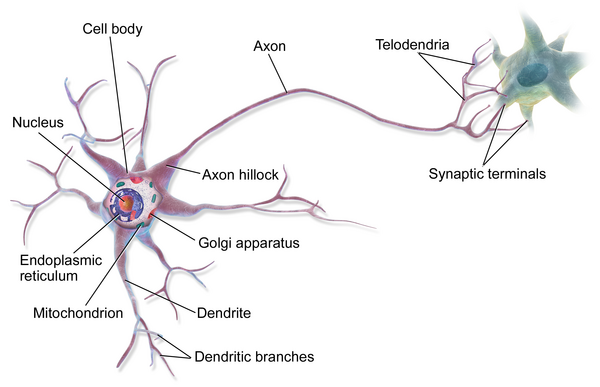
Spiking neurons communicate through discrete electrical pulses — mimicking biological neural signaling and enabling extreme energy efficiency through event-driven computation.
The architecture reveals the philosophy. Each chip contains 128 fully asynchronous neuron cores connected by a network-on-chip, plus six embedded x86 cores for orchestration. Every inter-core communication takes the form of a spike message — an event-driven packet processed only when it arrives, consuming near-zero energy during silence. This is the fundamental insight: a GPU must clock its entire massive array whether the data is meaningful or not. A neuromorphic chip does work only when something happens. In a world of sparse, bursty signals — sensor feeds, audio streams, anomaly detection — this difference is not incremental. It is categorical.
In April 2024, Intel scaled Loihi 2 into something unprecedented: Hala Point, the world’s first neuromorphic system exceeding one billion neurons. Deployed at Sandia National Laboratories, Hala Point integrates 1,152 Loihi 2 chips to model 1.15 billion neurons — over ten times the neuron capacity and twelve times the performance of Intel’s previous Pohoiki Springs system [5]. Mike Davies, director of Intel’s Neuromorphic Computing Lab, framed the stakes without ambiguity: “The computing cost of today’s AI models is rising at unsustainable rates. The industry needs fundamentally new approaches capable of scaling” [5].
The most striking empirical result arrived in November 2024, when Intel Labs published CLP-SNN — Continually Learning Prototypes on a Spiking Neural Network — running natively on Loihi 2. The numbers are not marginal improvements. They are a different regime entirely: 70x faster latency (0.33 milliseconds versus 23.2 milliseconds) and 5,600x greater energy efficiency (0.05 millijoules versus 281 millijoules per inference) compared to the best alternative running on an edge GPU [6].
Consider what those numbers mean in practice. An autonomous drone classifying objects in real time could run its perception pipeline for days on a battery that a GPU would drain in minutes. A medical wearable performing continuous neural signal analysis could operate for months between charges. A satellite performing on-board image triage could process a hundred times more data within its power budget. The 5,600x efficiency gap is not a benchmarking curiosity — it is the difference between applications that are physically possible and those that are not.
IBM NorthPole: When Architecture Trumps Moore’s Law
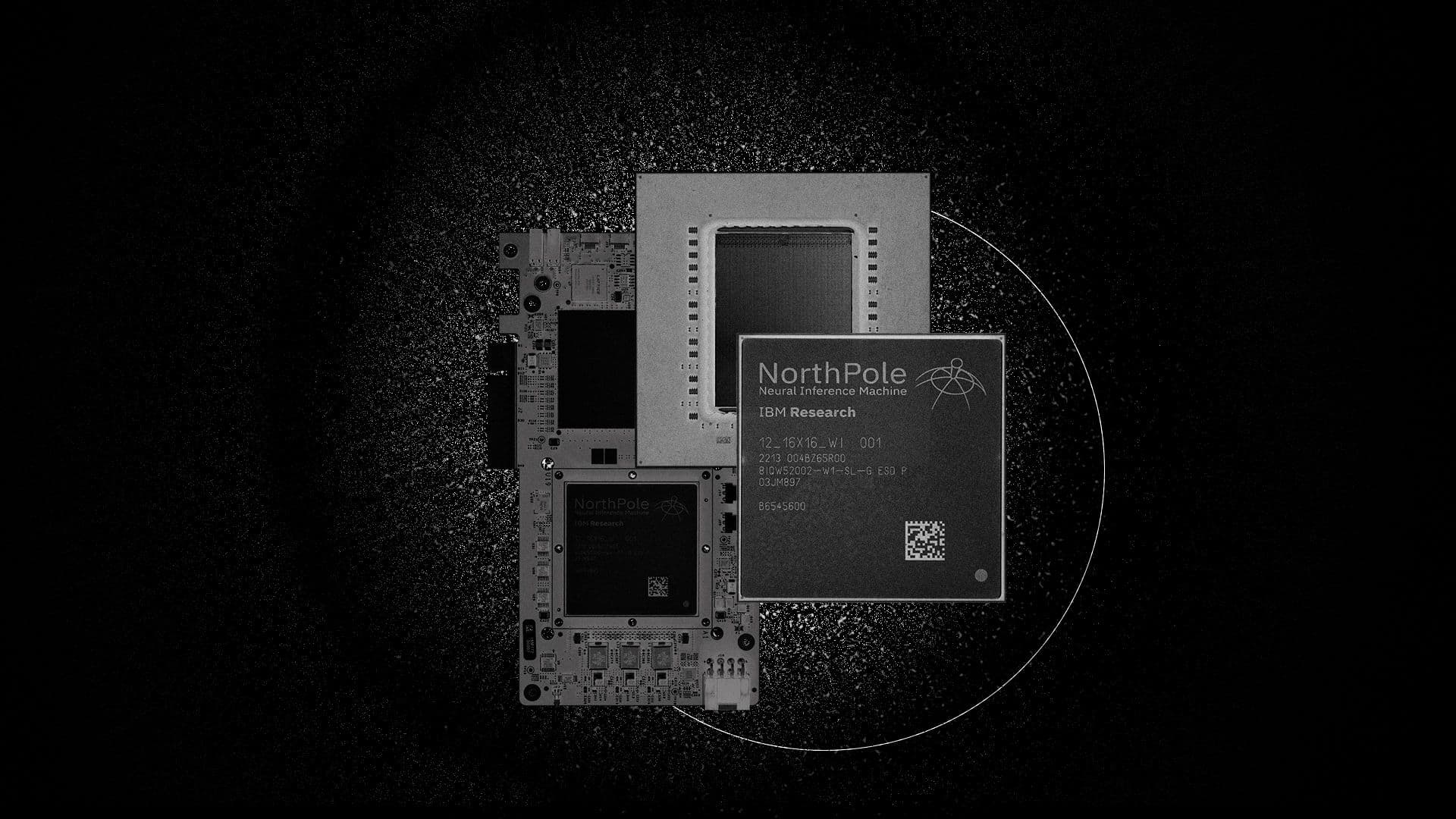
IBM’s NorthPole AI chip prototype — a brain-inspired neural inference architecture that eliminates the von Neumann bottleneck by intertwining compute and memory on a single chip. (Source: IBM Research)
IBM’s NorthPole takes a radically different approach. Where Loihi 2 embraces spiking neural networks and on-chip learning, NorthPole is a pure inference accelerator for conventional deep networks — but built on a brain-inspired architecture that eliminates the von Neumann bottleneck entirely. The key innovation: no off-chip memory. No centralized memory at all. Compute and memory are intertwined at every level of the chip, so data never has to travel far to be processed.
Dharmendra Modha, who has led IBM’s neuromorphic effort for nearly two decades, puts the design principle with characteristic precision: “NorthPole forges a completely different path from the von Neumann architecture” [7].
The results, published in Science in October 2023, stand as some of the most compelling silicon benchmarks in recent memory. Built on a 12-nanometer process — two full nodes behind the cutting edge — NorthPole achieves 25x greater energy efficiency than comparable 12nm GPUs and 14nm CPUs on ResNet-50 inference. More remarkably, it outperforms all existing specialized inference chips, including those fabricated on far more advanced 4nm processes [8][9]. Let that sink in: a chip built on older, cheaper manufacturing technology beating newer, more expensive chips through sheer architectural superiority.
This is the most powerful vindication of Modha’s dictum: “Architecture trumps Moore’s Law.” And it carries a profound implication. The semiconductor industry has spent trillions of dollars chasing smaller transistors. NorthPole demonstrates that rethinking how transistors are organized can yield gains that dwarf what shrinking them delivers. As Modha wrote: “Because physics (silicon scaling) is delivering progressively slower gains, therefore, looking to mathematics (architecture) is a way to profoundly shift the trajectory of energy consumption” [9].
NorthPole is roughly 4,000x faster than IBM’s earlier TrueNorth chip from 2014 — a pace of architectural improvement sustained across two decades of research, including a fourteen-year partnership with DARPA and the U.S. Department of Defense [9]. NorthPole is inference-only, which limits its immediate commercial scope. But its significance is not as a product — it is as proof that the von Neumann bottleneck is a choice, not a law of nature.
SpiNNaker2: The Pragmatist’s Bet
SpiNNaker2, developed at TU Dresden and commercialized by SpiNNcloud Systems, represents a third philosophy entirely. Where Intel pursues spiking purity and IBM pursues architectural elegance, SpiNNaker2 bets on flexibility. Each chip contains 152 ARM-based low-power processing elements arranged in a globally asynchronous, locally synchronous architecture. The design can run conventional deep neural networks, spiking neural networks, and neural-symbolic models on the same hardware [10].
The lineage is distinguished: SpiNNaker2 descends from Steve Furber’s original SpiNNaker1. Furber is the co-creator of the ARM microprocessor — the architecture inside virtually every smartphone on Earth. His neuromorphic philosophy mirrors his approach to ARM: build something programmable and let the ecosystem find the applications.
In June 2025, Sandia National Laboratories deployed a SpiNNaker2 system commercially — one of the first large-scale neuromorphic deployments outside a pure research setting. The system simulates approximately 175 million neurons across 24 boards of 48 chips each, placing it among the five largest neuromorphic platforms in existence [11]. SpiNNcloud claims 18x GPU efficiency today, with a next-generation SpiNNext chip targeting 78x [11].
The most intriguing capability is neural-symbolic computing. CEO Hector Gonzalez emphasizes that SpiNNaker2 can scale “neural symbolic models, like reasoners that have a symbolic layer, where at the same time you have neural layers” [11]. This hybrid approach — combining the pattern-recognition prowess of neural networks with the logical rigor of symbolic reasoning — addresses one of the deepest limitations of current AI: its inability to reason reliably about abstract concepts. If neuromorphic hardware turns out to be the natural substrate for neural-symbolic AI, the commercial implications would extend far beyond edge computing.
The Synapse Frontier: Memristors and Analog Memory

The intersection of biological and digital computing. Neuromorphic chips aim to replicate the brain’s energy-efficient, event-driven processing model in silicon.
The chips described above are digital. But the brain is analog, and a parallel research track is pursuing analog synapses that could, in principle, achieve orders-of-magnitude higher density and lower power than any digital weight storage.
The foundation was laid by IBM Research’s seminal 2018 paper in Nature Communications, which demonstrated a “multi-memristive synaptic architecture” using phase-change memory devices, validated experimentally across more than one million individual PCM devices [12]. The core insight was elegant: a single memristive device cannot provide the precision needed for accurate neural network weights, but multiple devices per synapse, governed by a global counter-based arbitration scheme, can achieve the necessary dynamic range.
The field has advanced dramatically since. In January 2026, Nature Electronics published work from Peking University demonstrating hybrid memristor arrays that implement “fatigue STDP” — a biologically inspired learning rule that pairs short-term plasticity (fatigue) with long-term weight updates [13]. The architecture couples an interfacial dynamic memristor (volatile, short-term) with a hafnia-based device (non-volatile, long-term), creating an artificial synapse that behaves more like its biological counterpart than any previous hardware implementation.
Why does this matter? Conventional spike-timing-dependent plasticity “faces limitations in terms of adapting to high-frequency inputs, restricting their effectiveness in processing complex temporal information” [13]. Fatigue STDP overcomes this, enabling spiking networks that can handle temporally rich signals — the kind produced by real-world sensors operating in continuous time. This is a prerequisite for applications like real-time speech processing, robotic proprioception, and autonomous navigation, where the ability to learn from rapid, overlapping events is essential.
The practical challenges remain real: device variability, noise, and manufacturing yield. A 2025 Frontiers in Neuroscience paper addressed this directly, proposing CMOS-memristor hybrid synapse designs that combine the reliability of established CMOS processes with the analog memory capabilities of memristors [14]. The field is converging on hybrid solutions rather than betting everything on pure analog or pure digital — a pragmatism that suggests the engineering community is serious about deployment, not just publication.
The Math Surprise and the Road Ahead
In January 2026, Sandia National Laboratories announced a finding that caught the community off guard: neuromorphic computers are “shockingly good at math” — far better than previously assumed at solving complex mathematical problems [15]. If this result generalizes beyond initial benchmarks, it would dramatically expand the application space for neuromorphic hardware, moving it from its traditional strongholds in sensory processing and edge AI into scientific computing, optimization, and potentially even cryptography.
This is the kind of unexpected discovery that has historically catalyzed adoption of new computing paradigms. GPUs were not designed for deep learning; their suitability was discovered almost by accident, and the consequences reshaped an entire industry. Neuromorphic hardware solving mathematical problems well could trigger a similar cascade.
But tempered optimism is warranted. The field still lacks its undeniable killer application — the workload that makes neuromorphic not merely better but indispensable. Edge AI and continual learning are promising candidates, but they remain niche markets compared to the data-center-scale training that drives GPU demand. The memristor research suggests that device physics is maturing, but manufacturing-grade reliability remains unproven at scale. And the software ecosystem, while improving rapidly with frameworks like Intel’s open-source Lava, is still years behind the maturity of CUDA and its surrounding toolchain [4].
The historical analogy remains instructive. CUDA launched in 2007; it took nearly a decade before GPU programming became mainstream in AI research. Neuromorphic software is at a comparably early stage, but the existence of open frameworks and the arrival of gradient-based training for spiking neural networks as an “off-the-shelf technique” [2] suggest the trajectory is bending toward accessibility.
The Shape of What Comes Next
The most probable near-term future is not revolution but coexistence: neuromorphic accelerators handling specific workloads alongside GPUs and CPUs, much as GPUs themselves coexist with the CPUs they were once expected to replace. Intel’s Loihi 2 has produced efficiency gains too large to dismiss. IBM’s NorthPole has proven that architectural innovation can outperform process-node advancement — a 12nm chip outrunning 4nm rivals. SpiNNaker2 has shown that neuromorphic systems can leave the lab and enter production environments.
But the deeper story is about the end of an assumption. For seven decades, we have taken for granted that intelligence — artificial or otherwise — must be implemented by shuttling data between separate pools of memory and logic. The brain never accepted this premise. It computes where it stores. It activates only what is needed. It learns continuously without being taken offline for retraining. Every major neuromorphic result of the past two years — Hala Point’s billion-neuron scale, NorthPole’s architectural supremacy, the fatigue-STDP memristors that learn like biological tissue — points toward a future where silicon finally begins to honor these principles.
Whether neuromorphic computing becomes the next GPU-scale platform shift or remains a specialized accelerator for edge workloads depends on two variables: whether the software ecosystem matures fast enough to exploit the hardware’s extraordinary theoretical advantages, and whether AI’s energy crisis grows severe enough to force the industry’s hand. On current trajectory, both conditions appear increasingly likely. The brain’s design is 500 million years old. We are only just beginning to take its lessons seriously.
References
- D. Kudithipudi et al., “Neuromorphic Computing at Scale,” Nature, vol. 637, pp. 801-812, January 22, 2025. Available: https://www.nature.com/articles/s41586-024-08253-8
- D. R. Muir and S. Sheik, “The Road to Commercial Success for Neuromorphic Technologies,” Nature Communications, vol. 16, art. 3586, April 15, 2025. Available: https://www.nature.com/articles/s41467-025-57352-1
- “Intel’s Neuromorphic Chip Gets A Major Upgrade,” IEEE Spectrum, September 2021. Available: https://spectrum.ieee.org/neuromorphic-computing-with-lohi2
- Intel Corporation, “Intel Advances Neuromorphic with Loihi 2, New Lava Software Framework and New Partners,” September 30, 2021. Available: https://www.intc.com/news-events/press-releases/detail/1502/
- Intel Corporation, “Intel Builds World’s Largest Neuromorphic System to Enable More Sustainable AI,” April 17, 2024. Available: https://newsroom.intel.com/artificial-intelligence/intel-builds-worlds-largest-neuromorphic-system-to-enable-more-sustainable-ai
- E. Hajizada et al., “Real-time Continual Learning on Intel Loihi 2,” arXiv:2511.01553, November 2024. Available: https://arxiv.org/abs/2511.01553
- IBM Research, “IBM Research’s New NorthPole AI Chip,” October 19, 2023. Available: https://research.ibm.com/blog/northpole-ibm-ai-chip
- “IBM Debuts Brain-Inspired Chip For Speedy, Efficient AI,” IEEE Spectrum, October 2023. Available: https://spectrum.ieee.org/neuromorphic-computing-ibm-northpole
- D. S. Modha et al., “NorthPole: Neural Inference at the Frontier of Energy, Space, and Time,” Science, October 19, 2023. Available: https://www.science.org/doi/10.1126/science.adh1174
- H. A. Gonzalez et al., “SpiNNaker2: A Large-Scale Neuromorphic System,” arXiv:2401.04491, January 2024. Available: https://arxiv.org/abs/2401.04491
- J. Burt, “Sandia Deploys SpiNNaker2 Neuromorphic System,” The Next Platform, June 16, 2025. Available: https://www.nextplatform.com/compute/2025/06/16/sandia-deploys-spinnaker2-neuromorphic-system/
- I. Boybat et al., “Neuromorphic Computing with Multi-Memristive Synapses,” Nature Communications, vol. 9, art. 2514, June 28, 2018. Available: https://www.nature.com/articles/s41467-018-04933-y
- B. Dang et al., “Spiking Neural Networks with Fatigue Spike-Timing-Dependent Plasticity Learning Using Hybrid Memristor Arrays,” Nature Electronics, vol. 9, pp. 213-224, January 15, 2026. Available: https://www.nature.com/articles/s41928-025-01554-4
- “Design of CMOS-Memristor Hybrid Synapse and Its Application for Noise-Tolerant Memristive Spiking Neural Network,” Frontiers in Neuroscience, art. 1516971, 2025. Available: https://www.frontiersin.org/journals/neuroscience/articles/10.3389/fnins.2025.1516971/full
- T. Rummler, “Brain-Inspired Computers Are Shockingly Good at Math,” Sandia National Laboratories Lab News, January 15, 2026. Available: https://www.sandia.gov/labnews/2026/01/15/brain-inspired-computers-are-shockingly-good-at-math/
This digest was produced by AaBot using real-time research from Nature, Nature Communications, Nature Electronics, Science, IEEE Spectrum, Intel, IBM Research, The Next Platform, Frontiers in Neuroscience, and Sandia National Laboratories. Published April 12, 2026.