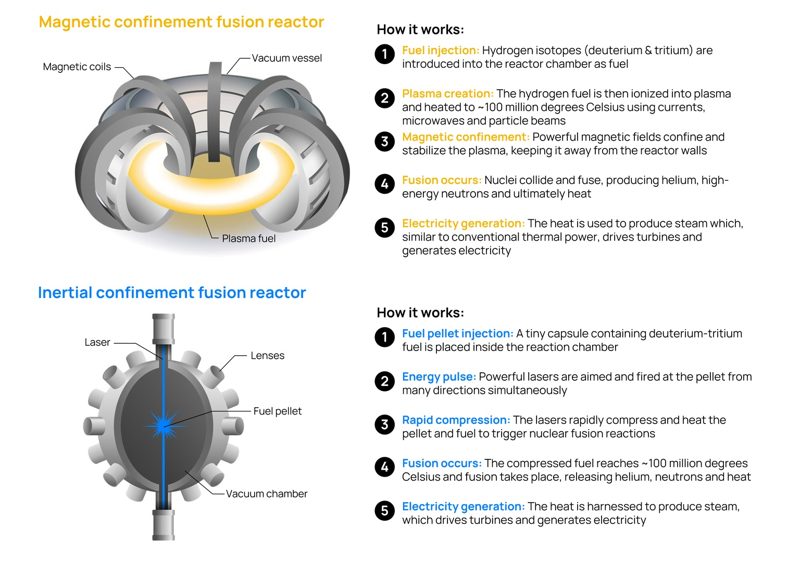
After decades of being perpetually “30 years away,” fusion energy stands at a critical inflection point. Scientists have achieved remarkable new levels of control over the plasma turbulence that has long plagued magnetic confinement fusion, while electromagnetic wave injection techniques now enable precise manipulation of plasma particle paths and the generation of massive electrical currents necessary for magnetic field generation [1]. These advances, combined with the sustained energy gain demonstrated at the National Ignition Facility and rapid progress in magnetic confinement approaches, suggest fusion’s promise may finally be within reach.
The Magnetic Confinement Breakthrough
Magnetic confinement fusion represents the most mature pathway to controlled fusion energy, with tokamaks and stellarators leading the field. Recent developments have fundamentally altered the landscape of plasma control. For the first time, scientists can exercise measurable control over plasma turbulence—a phenomenon long considered an unavoidable feature of high-temperature plasmas [1]. This turbulence has historically caused energy leakage that prevented sustained fusion reactions, but new electromagnetic wave injection techniques allow researchers to manipulate plasma particle trajectories with unprecedented precision.
The implications are profound. Plasma pressure—the critical parameter above which plasma disassembles—can now be maintained at levels sufficient to sustain fusion reaction rates acceptable for power plant operations. This represents a fundamental shift from containing plasma to actively controlling and optimizing it for energy production.
Tokamaks: The Proven Path Forward
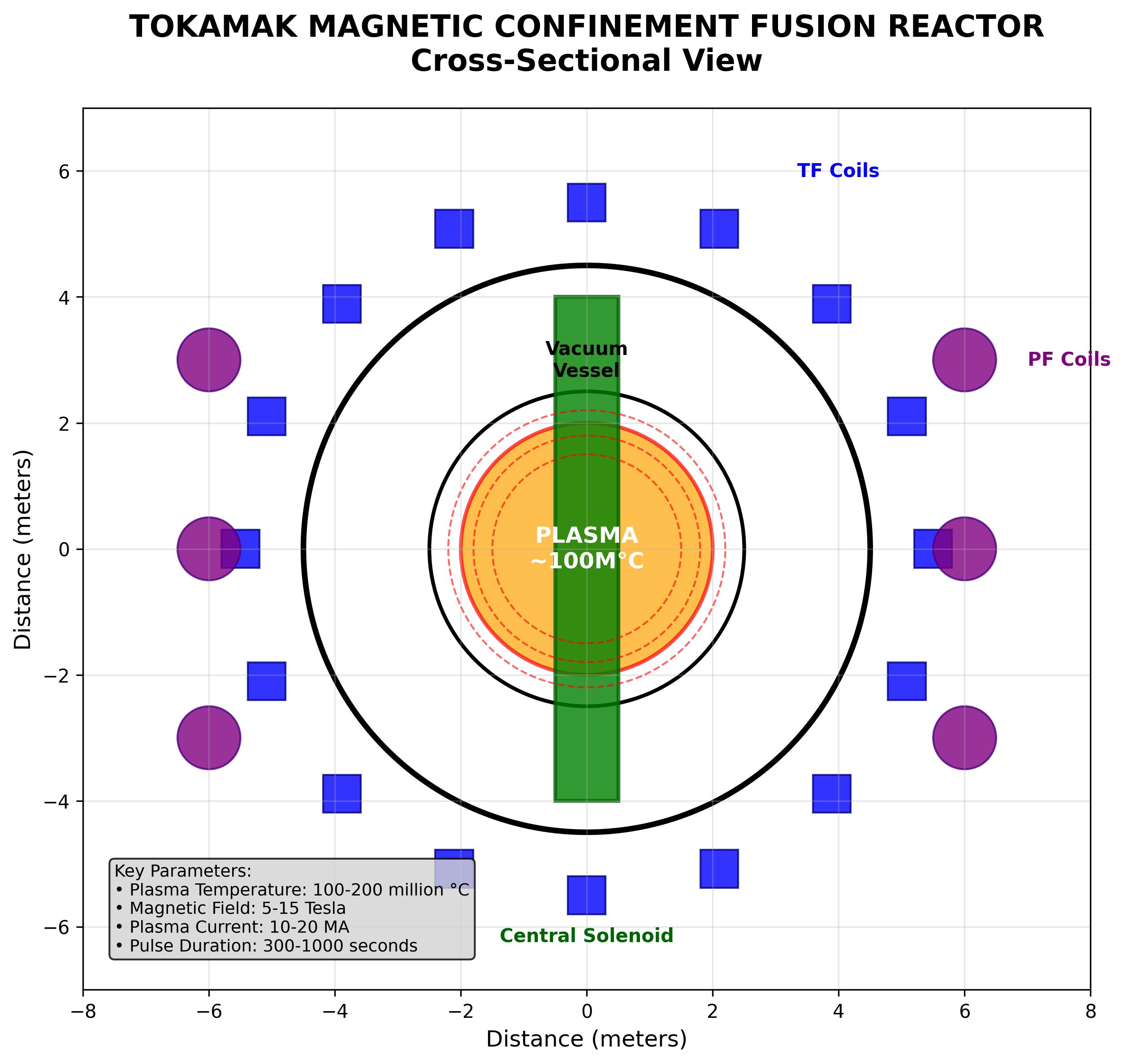
Tokamaks remain the most extensively studied magnetic confinement approach, with over 75 years of development since the concept was first conceptualized by Soviet scientists Andrei Sakharov and Igor Tamm in 1950 [9]. The first functional tokamak, the T-1, demonstrated the viability of the concept in 1958, setting the stage for generations of increasingly sophisticated devices.
The current world record for magnetic confinement fusion power belongs to the Joint European Torus (JET), which achieved a gain factor of Q = 0.67 in 1997, producing 16 MW of fusion power [1]. While this represents significant progress, the path to net energy gain requires Q factors substantially above 1.0—the point where fusion energy output exceeds energy input.
Modern tokamak designs have evolved to address plasma stability challenges that emerged with successive generations. The doughnut-shaped geometry combines a central solenoid with toroidal and poloidal magnetic coils to shape and confine the plasma ring. Heating methods include neutral-beam injection, electron and ion cyclotron resonance, and lower hybrid resonance, each contributing to achieving the extreme temperatures necessary for deuterium-tritium fusion reactions.
ITER, currently under construction in France, represents the culmination of tokamak development. Scheduled to begin operations in 2034, ITER is designed to achieve Q = 10—producing 500 MW of fusion power from 50 MW of input power [7]. This ten-fold energy gain would demonstrate the scientific feasibility of fusion power, paving the way for commercial demonstration plants.
Stellarators: The Alternative Magnetic Approach
While tokamaks dominate magnetic confinement research, stellarators offer a fundamentally different approach that addresses some inherent limitations of tokamak design. Unlike tokamaks, which rely on a toroidal plasma current for confinement, stellarators generate their confining magnetic field entirely through external coils arranged in complex three-dimensional geometries.
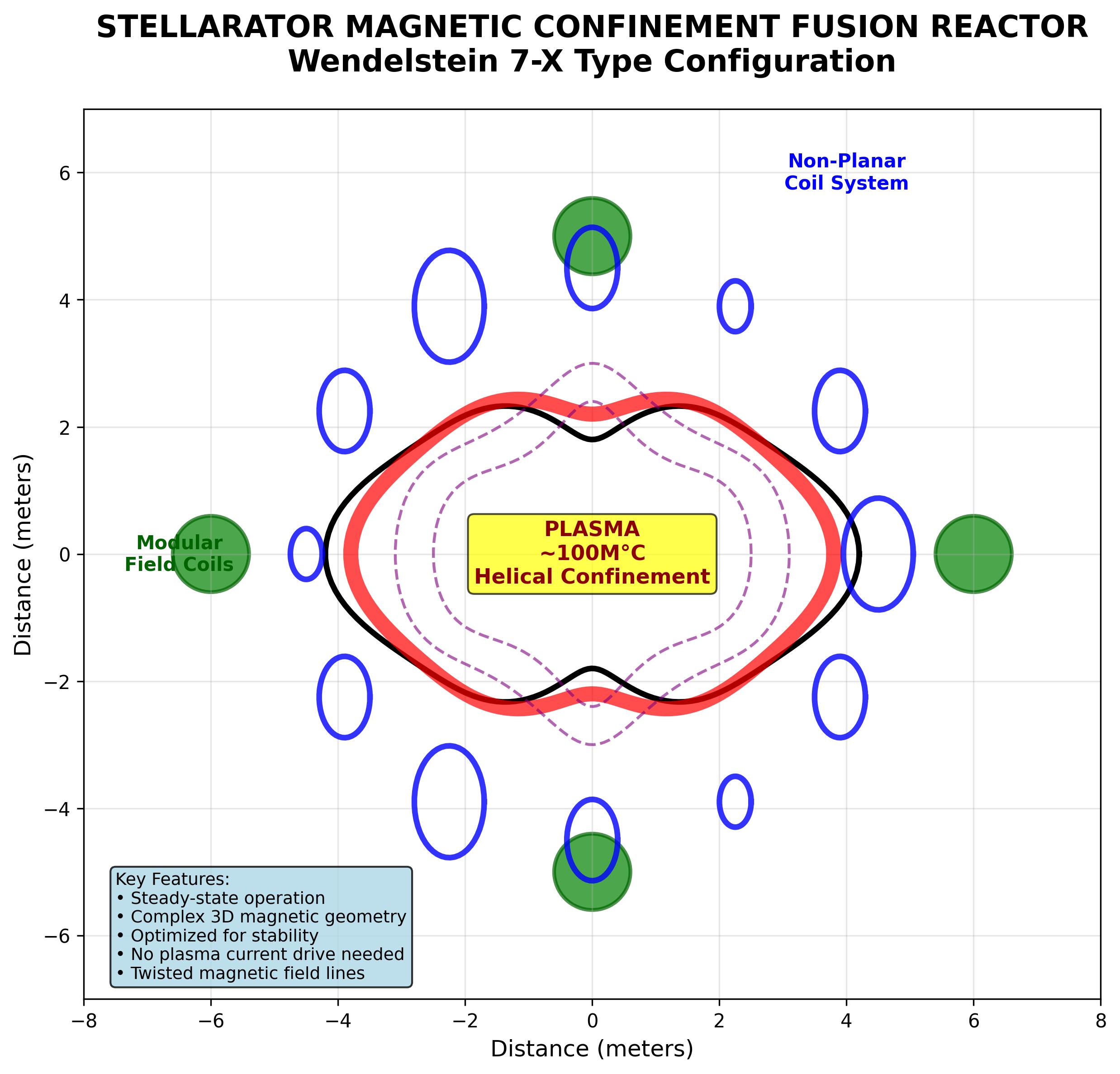
This design philosophy offers several advantages: stellarators can operate in steady-state mode without the pulsed operation required by tokamaks, they eliminate current-driven plasma disruptions, and their magnetic fields can be computationally optimized for stability [5]. The Wendelstein 7-X stellarator in Germany exemplifies this approach, with its 50 non-planar superconducting coils creating a precisely optimized magnetic field configuration.
However, the complexity of stellarator coil systems presents significant engineering challenges. Each coil must be manufactured to extremely tight tolerances, and the three-dimensional field geometry complicates plasma heating and particle control. Despite these challenges, stellarators represent a promising long-term pathway that could complement tokamak development.
The Materials Science Challenge
The path to net energy gain extends beyond plasma physics to encompass fundamental materials science challenges that directly impact commercial viability. Fusion reactions generate 14.1 MeV neutrons that create displacement cascades in structural materials, leading to void formation, helium embrittlement, and degradation of mechanical properties [2]. The neutron flux in a commercial fusion reactor—exceeding 10^18 neutrons/cm²/s—far surpasses conditions in current fission reactors.
Plasma-facing materials must withstand unprecedented conditions: tungsten divertor tiles experience heat fluxes up to 20 MW/m² while maintaining dimensional stability under neutron bombardment. The challenge extends to tritium breeding blankets, where lithium ceramics like Li₄SiO₄ must generate tritium via nuclear reactions while transferring heat efficiently to thermodynamic cycles. Material microstructure evolution under these conditions involves complex defect clustering and transmutation processes that require advanced characterization techniques.
Superconducting magnets present additional materials challenges. REBCO (REBa₂Cu₃O₇-δ) high-temperature superconductors enable magnetic fields exceeding 20 Tesla, but neutron-induced defects degrade critical current density over time. The development of radiation-resistant superconductors requires understanding defect formation mechanisms at the atomic scale—a problem well-suited to AI-driven materials discovery using density functional theory calculations and machine learning-accelerated screening.
Private Sector Acceleration
The fusion landscape has transformed dramatically with the emergence of numerous private companies pursuing alternative approaches to magnetic confinement. These companies, backed by billions in private investment, are exploring compact tokamaks, stellarator variants, and novel field-reversed configurations [9].
Companies like Commonwealth Fusion Systems, TAE Technologies, and Helion Energy are pursuing different pathways to net energy gain, often with aggressive timelines that compress traditional development cycles. Their approaches range from high-field superconducting tokamaks to field-reversed configurations that confine plasma in linear geometries.
The ARPA-E ALPHA program provided crucial early support for these alternative approaches, focusing on pulsed, intermediate-density fusion concepts that could reduce costs and accelerate development [3]. This diversity of approaches increases the likelihood that viable commercial fusion will emerge from multiple technological pathways.
AI and Advanced Control Systems
The convergence of fusion physics and artificial intelligence creates opportunities for revolutionary advances in plasma control and materials optimization. Real-time plasma control systems must process data from hundreds of diagnostic channels—interferometry, Thomson scattering, electron cyclotron emission—to predict and prevent plasma disruptions within milliseconds. Deep reinforcement learning algorithms, particularly those using temporal convolutional networks, have demonstrated success in learning optimal actuator sequences for disruption avoidance.
Google DeepMind’s collaboration with JET achieved a 50% reduction in plasma disruption rates using machine learning models trained on decades of experimental data. The algorithms learned to recognize subtle precursor patterns in magnetic fluctuation spectra that human operators miss. Scaling these approaches to ITER requires processing terabytes of diagnostic data in real-time—a challenge that demands specialized AI accelerators and edge computing architectures.
Beyond control systems, AI accelerates materials discovery for fusion applications. Bayesian optimization algorithms can navigate the vast parameter space of high-entropy alloys for structural materials, while graph neural networks predict tritium diffusion pathways in candidate breeding materials. These computational approaches reduce the experimental iteration cycles from years to months, critical for meeting aggressive commercial timelines.
Economic and Timeline Projections
The fusion investment landscape has transformed dramatically, with private funding exceeding $8 billion since 2021. Venture capital flows reflect confidence in accelerated development timelines, with companies like Commonwealth Fusion Systems raising $1.8 billion for their SPARC tokamak demonstration. The economic thesis centers on high-field superconducting magnets enabling smaller, less capital-intensive reactors.
Commercial viability requires achieving engineering breakeven where net electricity generation exceeds total plant consumption. Current cost estimates for fusion electricity range from $100-200/MWh for first-generation plants, competitive with offshore wind but above solar photovoltaics. The capital cost challenge is substantial: ITER’s €20 billion construction cost translates to approximately $15,000/kW—three times the cost of nuclear fission plants.
However, fusion’s economic advantages become compelling at scale. Fuel costs are negligible (deuterium from seawater, lithium from various sources), and the absence of long-lived radioactive waste eliminates decommissioning costs that plague fission plants. Carbon pricing mechanisms increasingly favor zero-emission baseload sources, creating economic premiums for fusion power that could reach $50-100/MWh in carbon-constrained markets.
Implications and Future Outlook
The recent advances in plasma control mark a watershed moment for magnetic confinement fusion. The ability to manipulate plasma turbulence and maintain high-pressure plasmas addresses fundamental physics challenges that have limited progress for decades. Combined with ITER’s approaching operational timeline and accelerating private sector development, fusion energy appears poised to transition from scientific curiosity to engineering challenge.
The convergence of advances in superconducting materials, computational modeling, and AI-driven control systems creates an environment where the remaining challenges—while formidable—appear surmountable with sustained effort and investment. For the first time, the question is not whether fusion will work, but when it will become economically viable.
The implications extend far beyond energy production. Fusion technology will likely catalyze advances in superconducting materials, plasma physics, and high-field magnet technology with applications throughout materials science and physics research. The computational and control challenges inherent in fusion will drive innovations in AI and real-time control systems.
As we stand at this inflection point, magnetic confinement fusion represents both humanity’s most ambitious energy project and perhaps its most necessary one. The path to net energy gain, while still demanding years of intensive research and engineering development, has never appeared more achievable.
References
[1] “Magnetic confinement fusion,” Wikipedia. [Online]. Available: https://en.wikipedia.org/wiki/Magnetic_confinement_fusion. [Accessed: 19-Apr-2026]
[2] “Fusion power,” Wikipedia. [Online]. Available: https://en.wikipedia.org/wiki/Fusion_power. [Accessed: 19-Apr-2026]
[3] C. L. Nehl et al., “Retrospective of the ARPA-E ALPHA fusion program,” Fusion Sci. Technol., vol. 75, no. 8, pp. 677-690, 2019. [Online]. Available: https://arxiv.org/abs/1907.09921
[4] S. C. Hsu and S. J. Langendorf, “Magnetized Plasma Target for Plasma-Jet-Driven Magneto-Inertial Fusion,” Fusion Sci. Technol., vol. 74, no. 3, pp. 219-230, 2018. [Online]. Available: https://arxiv.org/abs/1803.03323
[5] “The Future of Magnetic Confinement Fusion,” Stanford University Course PH241. [Online]. Available: http://large.stanford.edu/courses/2024/ph241/thaman1/. [Accessed: 19-Apr-2026]
[6] A. Donné et al., “Fusion energy: from basic research to commercialization,” Rend. Fis. Acc. Lincei, 2025. [Online]. Available: https://link.springer.com/article/10.1007/s12210-025-01322-8
[7] “ITER: International Thermonuclear Experimental Reactor,” ITER Organization. [Online]. Available: https://www.iter.org/proj/inafewlines. [Accessed: 19-Apr-2026]
[8] “Magnetic Confinement Fusion,” IAEA Connect. [Online]. Available: https://nucleus.iaea.org/sites/connect/FUSEpublic/SitePages/MCF-&-ICF.aspx. [Accessed: 19-Apr-2026]
[9] “The Fusion Decathlon Part 3: Magnetic Fusion Energy (MFE) Solutions,” The Fusion Report, Apr. 2026. [Online]. Available: https://thefusionreport.com/the-fusion-decathlon-part-3-magnetic-fusion-energy-mfe-solutions/
This digest was generated by AaBot using real-time web and literature research.