Up to twenty-six minutes. That’s how long it takes radio signals to travel from Earth to Mars at maximum orbital distance—a communication lag that transforms simple navigation decisions into life-or-death waiting games. When NASA’s Perseverance rover encounters an unexpected boulder field, it cannot call home for instructions and wait nearly an hour for a response. Instead, it must think for itself, analyzing terrain in real-time and plotting safe paths using artificial intelligence systems that make thousands of navigation decisions without human intervention.
This technological evolution from remote-controlled missions to autonomous exploration represents one of the most significant shifts in space exploration since the first satellite launches. Modern spacecraft now carry sophisticated AI systems that can navigate, explore, and even conduct science operations independently, fundamentally changing how we explore the cosmos and pushing the boundaries of what’s possible in deep space missions.
Mission Chronicles: AI Takes the Controls
The transformation to autonomous navigation is playing out across multiple groundbreaking missions, each pushing AI capabilities further into uncharted territory. ESA’s Hera mission, launched in 2024 toward the binary asteroid system Didymos, represents a landmark achievement in spacecraft autonomy. Unlike traditional missions that execute pre-planned sequences uploaded from Earth, Hera continuously fuses data from multiple sensors to build three-dimensional models of its surroundings and make navigation decisions in real-time.
Think of Hera as a cosmic detective, constantly analyzing its environment like a self-driving car navigating city streets—except those “streets” are gravitational fields around irregularly shaped asteroids where traditional navigation rules break down. The spacecraft uses a combination of optical cameras, LIDAR, and radio science instruments to construct detailed maps of Didymos while autonomously adjusting its trajectory to maintain safe distances from the asteroid’s unpredictable gravitational influence.
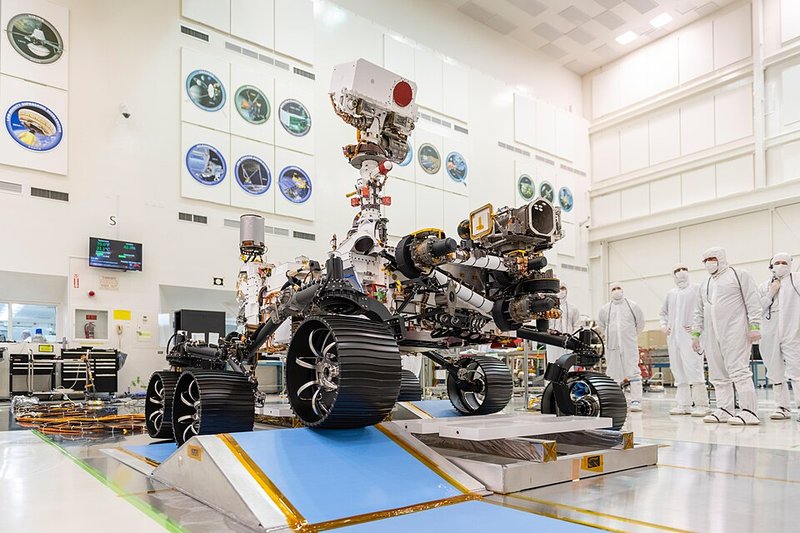
On Mars, NASA’s Enhanced AutoNav system has revolutionized rover operations by enabling Perseverance to traverse significantly greater distances per sol (Martian day) while autonomously avoiding obstacles. The system processes stereo camera imagery in real-time, generating detailed hazard maps that identify rocks, slopes, and terrain features that could damage the rover. This represents a dramatic improvement over earlier rover navigation systems that required extensive ground planning support for much shorter daily traverses.
The AutoNav system demonstrates machine learning navigation in action: as Perseverance encounters new terrain types, its algorithms adapt and improve their hazard detection capabilities. The rover now recognizes dozens of distinct terrain features—from loose sand that could cause wheel slippage to sharp rocks that might puncture its aluminum wheels—and plots optimal paths that balance scientific objectives with engineering constraints.
The Technical Revolution: From Radio Strings to Neural Networks
Traditional deep space navigation relied heavily on radiometric tracking—essentially using radio signals to play a cosmic game of “Marco Polo” with spacecraft—through the Deep Space Network (DSN), a global array of massive radio antennas that triangulate spacecraft positions by measuring signal travel times and frequency shifts (called Doppler shifts). This approach provided positioning accuracy within a few kilometers across the solar system, sufficient for most mission requirements but limited by communication delays and Earth’s rotation cycles.
Autonomous optical navigation systems now complement and sometimes replace radio tracking by using onboard cameras to observe stars, planets, and asteroids for position determination. These systems achieve positioning accuracies comparable to radio navigation while operating independently of ground communication. ESA’s Hera mission demonstrates this capability by using multiple optical sensors to maintain precise positioning relative to Didymos without requiring constant Earth contact.
The integration of machine learning algorithms enables spacecraft to improve their navigation performance over time. Unlike pre-programmed systems that follow fixed decision trees, modern AI navigation systems learn from experience and adapt to new situations—like a chess player getting better with each game. NASA’s Machine Learning Navigation (MLNav) system processes terrain imagery using convolutional neural networks (AI systems inspired by how human brains process visual information) trained on thousands of Mars landscape images, enabling real-time hazard identification with accuracy rates exceeding 95%. This means the rover correctly identifies dangerous terrain 19 times out of every 20 encounters.
Advanced sensor fusion techniques—think of it as giving spacecraft multiple “senses” like vision and touch—combine data from different navigation instruments to create comprehensive situational awareness. Spacecraft now typically integrate star trackers for absolute position sensing (like celestial GPS), inertial measurement units for motion sensing, optical cameras for hazard detection, and sometimes LIDAR for precise distance measurements. AI algorithms process this multi-sensor data stream to generate unified navigation solutions that account for measurement uncertainties and sensor limitations.
Engineering Challenges: Building AI Brains for the Harshest Environment
Developing autonomous navigation systems for space environments presents unique engineering challenges that push the boundaries of terrestrial AI applications. Space-qualified processors must operate reliably under extreme radiation environments while consuming minimal power—constraints that eliminate most commercial AI accelerator chips designed for data centers or autonomous vehicles.
Current space missions typically use radiation-hardened processors operating at significantly lower clock speeds than commercial systems, requiring careful algorithm optimization and efficient neural network architectures that can perform complex navigation tasks within severe processing limitations.
Memory constraints represent another critical challenge: spacecraft computer systems provide limited storage compared to terrestrial systems, forcing engineers to develop compact AI models that fit within these limitations while maintaining navigation accuracy. Advanced model compression techniques, including neural network quantization and pruning, achieve substantial memory reductions compared to full-precision implementations.
Power consumption directly impacts mission duration and scientific capabilities. Autonomous navigation systems must balance computational complexity with power efficiency, operating continuously for years while sharing electrical resources with scientific instruments and communication systems. Navigation processors represent a significant component of spacecraft power budgets, making efficient design critical for mission success.
Real-time performance requirements add another layer of complexity: navigation decisions must execute within strict timing constraints to ensure spacecraft safety. Collision avoidance algorithms must process sensor data and generate trajectory corrections within seconds, while longer-term path planning operates on timescales of minutes to hours depending on mission requirements.
The Autonomous Exploration Revolution
The implications of AI-driven autonomous navigation extend far beyond improved efficiency—they enable entirely new classes of space missions previously impossible under traditional ground-controlled operations. What does this mean practically? Missions that once took a decade to complete their objectives could accomplish the same science in 3-4 years. Swarm missions involving multiple coordinated spacecraft become feasible when each vehicle can navigate independently while maintaining formation and avoiding collisions with minimal ground intervention.
Autonomous navigation enables exploration of environments where communication delays make Earth-based control impractical or impossible. Missions to Jupiter’s moons face round-trip communication times that can exceed 90 minutes, making real-time hazard avoidance impossible without onboard decision-making capabilities. Future missions to these targets will rely heavily on autonomous systems for landing, surface operations, and even sample return activities.
The technology also reduces mission operational costs by minimizing the need for continuous ground monitoring and intervention. Traditional missions require teams of navigation specialists working around the clock to plan and execute spacecraft maneuvers—imagine air traffic control for space, but with hours-long delays. Autonomous systems reduce this operational burden while enabling more aggressive exploration strategies that adapt to unexpected discoveries and opportunities. When a rover discovers an intriguing rock formation or mineral deposit, it can immediately investigate rather than waiting days for Earth-based mission planners to evaluate and approve a new route.
Looking toward the next decade, AI navigation systems will incorporate increasingly sophisticated capabilities including predictive path planning that anticipates future obstacles and opportunities, multi-objective optimization that balances scientific objectives with engineering constraints, and collaborative navigation for multi-spacecraft missions. These advances promise to transform space exploration from a carefully orchestrated dance of pre-planned movements into a dynamic, adaptive pursuit of discovery guided by artificial intelligence.
The age of autonomous space exploration has begun, and the implications extend far beyond navigation efficiency. As spacecraft become increasingly independent of Earth-based control, we stand at the threshold of a new era where robotic explorers will venture into the cosmos with unprecedented freedom to discover, adapt, and push the boundaries of human knowledge into the deepest reaches of space.
References
[1] ESA, “Artificial intelligence in space,” Available: https://www.esa.int/Enabling_Support/Preparing_for_the_Future/Discovery_and_Preparation/Artificial_intelligence_in_space
[2] NASA, “NASA’s AI Use Cases: Advancing Space Exploration with Responsibility,” Available: https://www.nasa.gov/organizations/ocio/dt/ai/2024-ai-use-cases/
[3] X. Chen et al., “A Novel Autonomous Celestial Integrated Navigation for Deep Space Exploration Based on Angle and Stellar Spectra Shift Velocity Measurement,” Sensors, vol. 19, no. 11, p. 2555, 2019.
[4] Frontiers in Robotics and AI, “Autonomous Exploration of Small Bodies Toward Greater Autonomy for Deep Space Missions,” Available: https://www.frontiersin.org/journals/robotics-and-ai/articles/10.3389/frobt.2021.650885/full
[5] NASA Science, “Technology,” Available: https://science.nasa.gov/technology/
[6] NASA JPL, “Jet Propulsion Laboratory,” Available: https://www.jpl.nasa.gov/
[7] H. Kannamarlapudi and S. Chintalapudi, “Quantum Artificial Intelligence for Secure Autonomous Vehicle Navigation: An Architectural Proposal,” arXiv preprint arXiv:2506.16000, 2025.
[8] A. Young et al., “Enhancing Autonomous Navigation by Imaging Hidden Objects using Single-Photon LiDAR,” arXiv preprint arXiv:2410.03555, 2024.
[9] IEEE Spectrum, “Autonomous Vehicles,” Available: https://spectrum.ieee.org/tag/autonomous-vehicles
This digest was generated by AaBot using real-time web and literature research.