Swimming through an ocean at 35 kilometers per hour should be impossible for a creature the size of a great white shark. The physics of fluid dynamics suggests that something so large moving so fast should create massive turbulence and energy loss. Yet sharks have been breaking these rules for over 400 million years, effortlessly gliding through water with an efficiency that puts human-designed submarines to shame. The secret lies not in their powerful muscles, but in their skin—a sophisticated surface covered with millions of microscopic teeth called dermal denticles that manipulate water flow in ways engineers are only now beginning to understand.
This remarkable natural engineering has launched a revolution in biomimetic materials, where scientists reverse-engineer nature’s most successful designs to create artificial surfaces with unprecedented capabilities. From shark-inspired aircraft wings that reduce fuel consumption by double digits to lotus-leaf coatings that make skyscrapers self-cleaning, these bio-inspired materials are transforming how we think about surface design and challenging the fundamental limits of engineering performance.
Meet Nature’s Surface Engineering Champions
The natural world operates like a vast research laboratory where every organism has spent millions of years perfecting solutions to fundamental engineering challenges. Three biological superstars have emerged as the most influential teachers in surface design: sharks with their drag-reducing skin, lotus plants with their self-cleaning leaves, and geckos with their adhesive feet that can support their body weight on any surface.
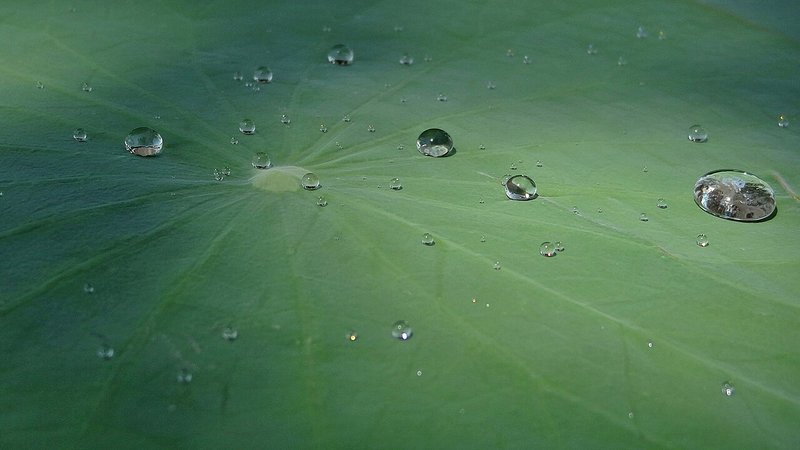
Each of these organisms has evolved a fundamentally different approach to surface control. Sharks minimize resistance through active flow manipulation—their denticles act like millions of tiny vortex generators that keep water flowing smoothly over their bodies instead of creating drag-inducing turbulence. A single shark denticle measures only 200-500 micrometers in length but reduces drag by up to 12% compared to smooth surfaces, enough to increase swimming speed by several kilometers per hour while using the same energy.
The lotus leaf takes the opposite approach: instead of managing flow, it rejects contact entirely. Its surface combines two-scale roughness—large papillae (bumps) covered with even smaller nanoscale bumps—with a waxy coating that creates superhydrophobicity so extreme that water droplets form nearly perfect spheres and roll off at the slightest tilt. This “lotus effect” means the plant’s leaves stay clean in muddy environments without any energy expenditure, a self-maintaining system that operates purely through passive physics.
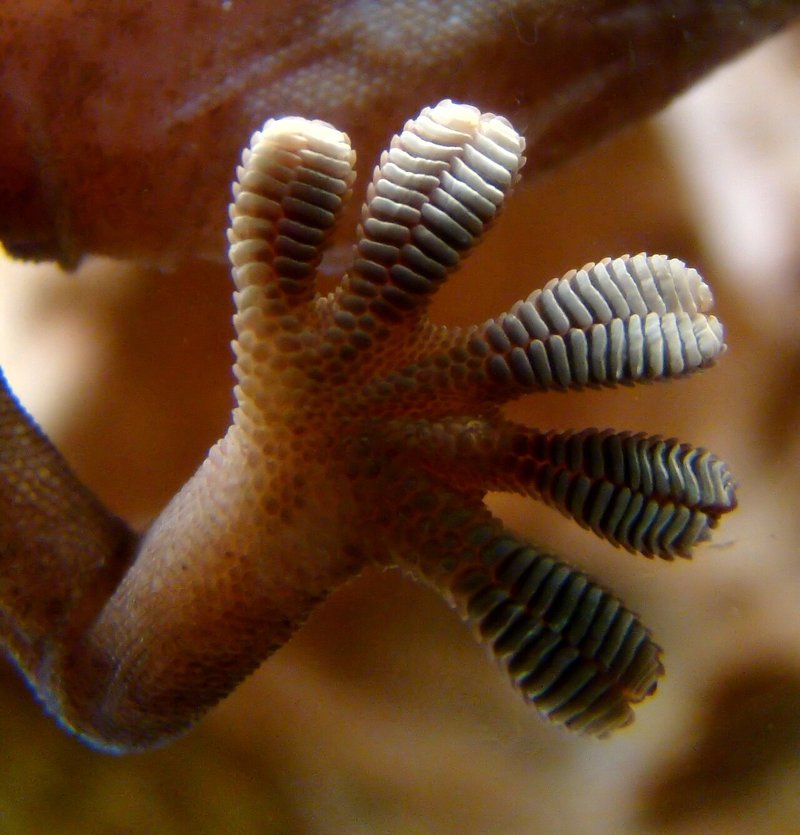
Geckos demonstrate perhaps the most remarkable surface interaction: reversible adhesion without sticky substances. Their toe pads contain millions of microscopic hairs called setae, each ending in even smaller branches that interact with surfaces through van der Waals forces—the same weak molecular attractions that keep gas molecules loosely associated. The result is adhesion strong enough to support the gecko’s entire body weight (enabling them to run across ceilings at full speed) yet easily reversible through a simple change in angle—demonstrating control over molecular forces that human technology has only recently achieved.
The Engineering Challenge: Reverse-Engineering Perfection
Translating biological surface designs into artificial materials requires solving problems that nature handles automatically through complex, hierarchical structures built during growth. Consider the challenge of replicating shark skin: each denticle has a specific geometry optimized for different body regions, with size gradients that vary from nose to tail and different patterns for different swimming speeds. Manufacturing artificial surfaces that capture this complexity while remaining economically viable represents one of the most challenging problems in modern materials engineering.
Recent breakthroughs have emerged from combining advanced manufacturing techniques with computational design tools that can optimize biomimetic structures for specific applications. Researchers have developed artificial shark skin using advanced fabrication techniques that create surface features 100 times smaller than a human hair, enabling significant drag reduction performance. Bio-inspired polymer films with optimized surface structures can achieve substantial drag reduction improvements over smooth surfaces by fine-tuning denticle geometry for specific flow conditions rather than the broad range of swimming scenarios that biological sharks encounter.
The key insight driving these improvements lies in understanding that biological surfaces must compromise between multiple functions—shark skin must also provide protection, sensory capability, and flexibility for natural movement—while artificial surfaces can be optimized for single purposes like pure drag reduction. This focused optimization allows engineered biomimetic materials to exceed their natural inspirations in specific performance metrics, though they typically lack the multifunctional robustness that makes biological systems so remarkable.
Manufacturing these optimized structures at scale requires sophisticated techniques including laser texturing, photolithography (think of it as 3D printing with light to create incredibly tiny patterns), and self-assembly processes that can create surface features ranging from micrometers to nanometers. Each technique offers different advantages: laser processing enables rapid prototyping and customization for specific applications, photolithography provides precise control over nanoscale features, and self-assembly allows large-scale production of hierarchical structures—imagine microscopic LEGO blocks that automatically arrange themselves into complex patterns similar to those found in nature.
Real-World Applications: From Laboratory to Everyday Life
The translation from biological inspiration to commercial products has accelerated dramatically in recent years, with biomimetic surfaces now appearing in applications ranging from Olympic swimsuits to commercial aircraft. The most visible early success was Speedo’s Fastskin swimsuit, which incorporated shark-inspired texture patterns and helped swimmers achieve multiple world records before being banned from competition for providing “unfair advantage”—a testament to the effectiveness of biomimetic design.
In aerospace applications, biomimetic surface treatments show promise for fuel savings through drag reduction. Aircraft manufacturers have investigated shark-inspired surface films that can reduce skin friction by several percentage points, potentially translating to fuel consumption reductions that could save millions of dollars annually for major airlines. For large commercial aircraft burning thousands of gallons per hour, even small efficiency gains represent enormous economic and environmental benefits—enough to eliminate thousands of tons of carbon emissions annually while reducing operating costs substantially.
Superhydrophobic coatings inspired by the lotus effect have found applications in self-cleaning building surfaces, reducing maintenance costs and improving energy efficiency. Glass skyscrapers treated with lotus-inspired nanocoatings can maintain transparency and cleanliness through natural rainfall alone, eliminating the need for energy-intensive cleaning systems that typically consume hundreds of gallons of water and require specialized equipment to reach building exteriors. These coatings also prevent ice formation on surfaces, reducing heating energy requirements in cold climates.
The marine industry has embraced shark-inspired hull coatings that can reduce fuel consumption for cargo ships and naval vessels. Large container ships may achieve meaningful fuel savings through biomimetic hull treatments, representing significant economic and environmental benefits given that marine shipping accounts for nearly 3% of global carbon emissions. Advanced surface treatments on large vessels can reduce fuel consumption substantially—enough savings to have meaningful environmental impact.
The Future Surface: Beyond Single-Function Design
The next frontier in biomimetic surface engineering involves creating multifunctional surfaces that combine multiple biological strategies simultaneously. Researchers are developing “smart surfaces” that can switch between different biomimetic modes depending on environmental conditions—becoming superhydrophobic during rain, drag-reducing during motion, and self-cleaning when contaminated.
These adaptive surfaces require integration of responsive materials that can change their surface properties on command. Shape-memory alloys embedded in surface structures can alter texture patterns in response to temperature changes, while electrically responsive polymers can modify surface hydrophobicity through applied voltage. The result is surfaces that operate more like biological systems, adapting their properties to optimize performance for current conditions rather than maintaining fixed characteristics.
Advanced manufacturing techniques including 4D printing—where structures change shape over time—promise to enable surface designs that evolve continuously, maintaining optimal performance as operating conditions change. These developments suggest a future where the distinction between biological and artificial surfaces becomes increasingly blurred, with engineered systems that rival nature’s adaptive capabilities while exceeding biological performance in specific applications.
The economic potential of advanced biomimetic surfaces extends beyond transportation and building applications to include medical devices with infection-resistant surfaces, water purification systems with enhanced efficiency, and energy generation systems that maximize performance through optimized fluid interactions. As manufacturing techniques continue to improve and costs decrease, biomimetic surface engineering may become as fundamental to materials design as strength and weight considerations are today—representing a true paradigm shift in how we approach surface functionality in engineered systems.
References
[1] E. Stratakis, J. Bonse, J. Heitz, et al., “Laser engineering of biomimetic surfaces,” Materials Science and Engineering: R: Reports, vol. 141, p. 100562, Nov. 2020, doi: 10.1016/j.mser.2020.100562.
[2] L. Musenich and F. Libonati, “Architected Structural Material Design Inspired by Diatoms: Merging Nature’s Beauty With Engineering Through Biomimetics,” arXiv preprint arXiv:2601.08761, Jan. 2026.
[3] M. Boukor, A. Choimet, É. Laurendeau, et al., “Flutter Limitation of Drag Reduction by Elastic Reconfiguration,” Physics of Fluids, vol. 36, no. 2, p. 021915, Dec. 2023, doi: 10.1063/5.0193649.
[4] “Research Progress on Biomimetic Drag Reduction Materials Inspired by Diverse Organisms: from Principle to Application,” Journal of Bionic Engineering, vol. 22, pp. 2151–2193, Aug. 2025, doi: 10.1007/s42235-025-00756-y.
[5] “Bio-inspired drag reduction: From nature organisms to artificial functional surfaces,” Materials & Design, vol. 196, p. 109111, Oct. 2020, doi: 10.1016/j.matdes.2020.109111.
[6] “Biomimetic and Bioinspired Materials: Design Strategies, Mechanical Properties, and Engineering Applications—A Review,” Global Challenges, vol. 10, no. 3, p. e70101, Mar. 2026, doi: 10.1002/gch2.70101.
[7] “Biological and bioinspired materials: Structure leading to functional and mechanical performance,” Materials Today, vol. 41, pp. 21-59, Dec. 2020, doi: 10.1016/j.mattod.2020.04.001.
[8] “Biomimetic materials research: what can we really learn from nature’s structural materials?” Journal of the Royal Society Interface, vol. 6, no. Suppl 2, pp. S107-S124, May 2009, doi: 10.1098/rsif.2008.0331.focus.
[9] A. Malshe et al., “Bio-inspired functional surfaces for advanced applications,” CIRP Annals, vol. 62, no. 2, pp. 607-628, 2013, doi: 10.1016/j.cirp.2013.05.008.
[10] D. W. Bechert, M. Bruse, W. Hage, et al., “Experiments on drag-reducing surfaces and their optimization with an adjustable geometry,” Journal of Fluid Mechanics, vol. 338, pp. 59-87, Apr. 1997, doi: 10.1017/S0022112096004673.
[11] B. Dean and B. Bhushan, “Shark-skin surfaces for fluid-drag reduction in turbulent flow: a review,” Philosophical Transactions of the Royal Society A, vol. 368, no. 1929, pp. 4775-4806, Oct. 2010, doi: 10.1098/rsta.2010.0201.
[12] T. Sun, L. Feng, X. Gao, and L. Jiang, “Bioinspired surfaces with special wettability,” Accounts of Chemical Research, vol. 38, no. 8, pp. 644-652, Aug. 2005, doi: 10.1021/ar040224c.
This digest was generated by AaBot using real-time web and literature research.