Your laptop’s processor contains over 50 billion transistors, but getting power to them and data between them has become the real engineering nightmare. Not the transistors themselves—those keep shrinking beautifully—but the substrate beneath them, the material that connects the chip to the motherboard. For decades, this foundation has been built from organic polymers, essentially advanced plastics that bend and warp under the extreme demands of modern AI processors. Now, as trillion-transistor packages become reality, these organic materials have hit their physical breaking point. The solution? Replace plastic with precision glass, enabling interconnect densities 10 times higher while solving the thermal crisis that threatens to halt AI hardware progress.
This isn’t just another incremental upgrade. Intel’s announcement of industry-first glass substrates for 2027 data center processors represents a fundamental restructuring of how the world’s most powerful chips are built. When AI training runs push processors beyond 1000 watts and package sizes approach credit-card dimensions, traditional organic substrates simply warp, crack, or fail. Glass substrates maintain nanometer-precision flatness even under these extreme conditions, enabling the dense multi-chiplet architectures that power large language models with hundreds of billions of parameters.
The Warpage Wall: Why Organic Materials Can’t Keep Up
The crisis begins with scale. Modern AI processors aren’t single chips anymore—they’re massive assemblies of specialized chiplets, each optimized for different tasks. Modern AI GPUs like NVIDIA’s H100 series integrate tens of billions of transistors across multiple dies. AMD’s largest EPYC processors combine 12 separate chiplets into unified packages with total areas exceeding several thousand mm². These dimensions push organic substrates, which expand and contract with temperature, beyond their mechanical limits.
Think of organic substrates like a wooden deck in summer heat—as temperatures rise, the material expands and warps. For a small deck, this might mean a few millimeters of movement. But scale that up to credit-card size with nanometer-precision requirements, and tiny thermal expansions become catastrophic misalignments. Organic materials like Ajinomoto Build-up Film (ABF) have coefficients of thermal expansion around 14-18 parts per million per degree Celsius. Silicon, meanwhile, expands at only 2.5 ppm/°C. This mismatch creates mechanical stress that can crack solder connections, deform critical interfaces, or cause complete package failure as processors heat up during operation.
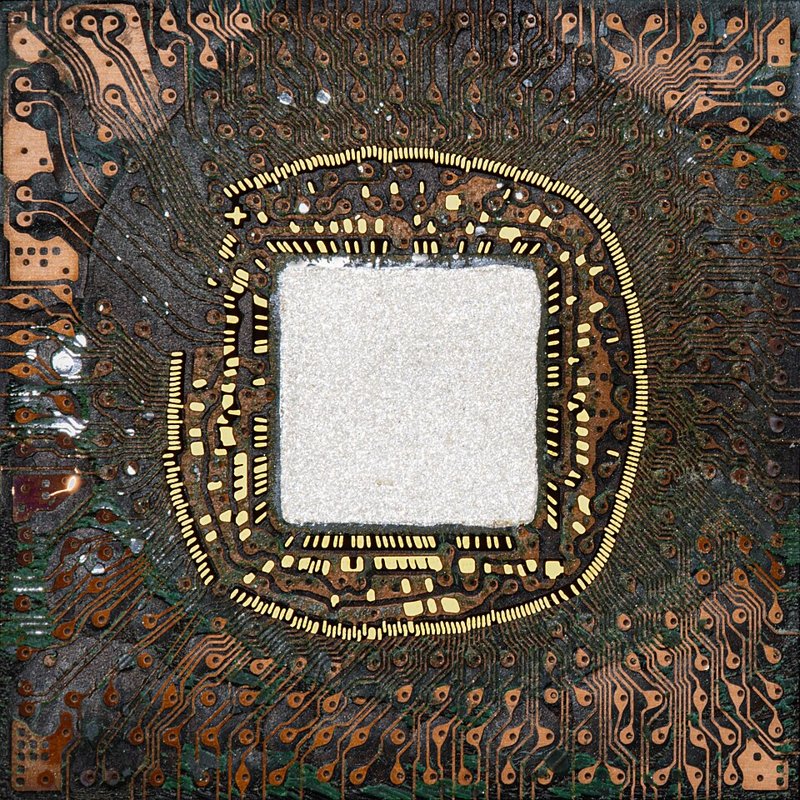
Intel’s glass substrates solve this fundamental mismatch with thermal expansion properties much closer to silicon. This improved compatibility means large AI packages can operate at high temperatures during intense training runs without the mechanical stress that destroys organic-based designs. For Intel’s upcoming processor generations implementing glass substrate packaging in the latter part of this decade, this thermal stability will enable much larger package sizes while maintaining the nanometer-precision needed for advanced interconnect spacing.
The flatness advantage proves equally critical. Organic substrates can warp by several micrometers across large areas, but advanced chiplet integration requires flatness tolerances measured in hundreds of nanometers. Glass substrates maintain this precision automatically through their crystalline structure, enabling the tight tolerances needed for optical interconnects and advanced memory stacking that will define next-generation AI accelerators.
Through-Glass Vias: Engineering the 10x Interconnect Revolution
The real breakthrough lies in Through-Glass Vias (TGVs)—microscopic tunnels etched through glass substrates using precision laser drilling. Unlike the mechanically or chemically drilled holes in organic substrates, TGVs can be created with aspect ratios (depth to width) exceeding 20:1. This enables interconnect densities of thousands of connections per mm², compared to hundreds per mm² for organic alternatives—delivering the 10x improvement that makes trillion-transistor packages feasible.
These aren’t simple holes. Each TGV represents a feat of precision engineering—imagine drilling a tunnel through a skyscraper’s foundation with the width of a single strand of spider silk. The diameter measures as small as 5 micrometers (about 10 times thinner than human hair) while reaching depths of 100 micrometers. The laser etching process, developed through Intel’s collaboration with Corning, creates perfectly cylindrical channels with smooth sidewalls that can be plated with copper to create electrical connections. This precision enables interconnect pitches (spacing between connections) below 20 micrometers—fine enough to match the advanced bump technologies used in leading-edge memory stacking.
For Samsung’s upcoming AI accelerator roadmap, TGV technology enables integration of high-bandwidth memory (HBM4) directly onto processor packages with unprecedented density. Each HBM4 stack requires over 1,000 individual connections, and placing multiple stacks on a single package demands the interconnect density that only glass substrates can provide. The result: AI processors with over 4 terabytes per second of memory bandwidth—enough to feed the data-hungry attention mechanisms that power large language models.
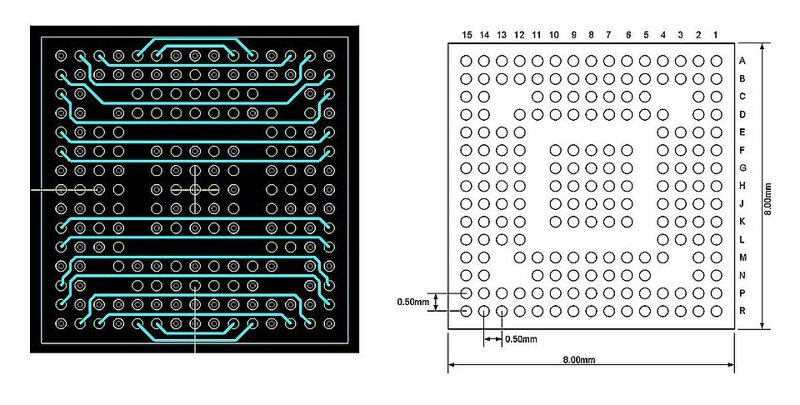
The manufacturing process for TGVs represents a convergence of semiconductor fabrication and precision glass processing. Intel’s production line uses ultrafast femtosecond lasers that can ablate glass with minimal heat-affected zones, preventing the micro-cracking that would compromise electrical performance. After drilling, each via is chemically treated to create smooth surfaces, then plated with barrier metals and filled with copper using electrochemical deposition—the same techniques used for advanced semiconductor metallization.
This process control enables not just higher density, but better electrical performance. TGVs have significantly lower resistance and capacitance than organic substrate connections, reducing signal loss by up to 40% compared to ABF alternatives. For high-frequency AI applications, where processors operate at multi-gigahertz speeds, this improved signal integrity directly translates to better performance and lower power consumption.
Industry Transformation: From Intel Labs to Volume Production
The transition to glass substrates represents a coordinated industry shift involving the entire semiconductor ecosystem. Intel’s announcement of volume production has triggered parallel developments across Asia’s manufacturing centers, with TSMC investigating glass panel-level packaging for advanced AI processors and Samsung developing glass substrate capabilities for its foundry customers. This shift feels like transitioning from building wooden houses to steel skyscrapers—the material upgrade enables entirely new architectural possibilities.
Rapidus, Japan’s ambitious semiconductor consortium, has announced plans to leapfrog traditional packaging approaches by implementing panel-level glass processing for their next-generation foundry operations. Their aggressive timeline targets 2027 production readiness, positioning Japan as a major player in the glass substrate supply chain. This panel-level approach processes multiple packages simultaneously on large glass sheets—similar to how LCD displays are manufactured—reducing costs while enabling the large package formats needed for AI accelerators.
The economic implications extend beyond manufacturing efficiency. Glass substrates enable yield improvements that directly impact AI chip costs. With organic substrates, a single warpage-induced defect can destroy an entire multi-thousand-dollar processor package. Glass substrates’ mechanical stability dramatically reduces these yield losses, potentially lowering AI processor costs by 15-20% despite the higher material costs of precision glass. For cloud providers deploying thousands of AI training processors, these savings translate to millions of dollars in reduced infrastructure costs.
Corning, leveraging decades of experience in display glass manufacturing, has emerged as Intel’s key partner for glass substrate supply. Their proprietary glass compositions, optimized for semiconductor applications, provide the thermal and mechanical properties needed for advanced packaging while maintaining the manufacturing scalability required for volume production. This partnership ensures supply chain stability as the industry scales glass substrate adoption.
The AI Hardware Future: Enabling Trillion-Transistor Architectures
The ultimate goal of glass substrate technology extends beyond solving current packaging problems—it’s about enabling entirely new categories of AI hardware that would be impossible with organic substrates. Consider the computational requirements for training GPT-5 or managing autonomous vehicle fleets: these applications demand processors with memory bandwidth measured in tens of terabytes per second and compute capabilities exceeding thousands of teraFLOPS.
Such performance levels require massive multi-chiplet architectures with dozens of specialized dies integrated into unified packages. Future AI training hardware may integrate numerous individual chiplets into very large package assemblies—formats that would be mechanically challenging with organic substrates but become achievable with glass technology.
The optical interconnect compatibility of glass substrates opens even more radical possibilities. Unlike organic materials, which absorb optical signals, glass enables on-package optical waveguides that can carry data at light speed between chiplets. This technology, currently in development at Intel Labs, could enable AI processors with internal communication bandwidth exceeding 100 terabytes per second—enough to support neural networks with trillions of parameters operating in real-time.
For the broader AI industry, glass substrates represent the infrastructure foundation that enables continued hardware scaling. As language models grow from hundreds of billions to trillions of parameters, and as AI capabilities expand from text generation to multimodal reasoning and robotics control, the underlying hardware must scale correspondingly. Glass substrates provide the packaging technology that makes this scaling economically and technically feasible.
The transition timeline suggests a major inflection point around 2027-2028, when glass substrate technology reaches volume production across multiple manufacturers. This timing aligns with the expected deployment of next-generation AI models that will require the enhanced packaging capabilities that glass enables. For researchers, engineers, and companies building AI-dependent systems, understanding this substrate transition provides crucial insight into the hardware capabilities that will define the next decade of artificial intelligence development.
This digest was generated by AaBot using real-time web and literature research.
References
[1] “Intel Unveils Industry-Leading Glass Substrates to Meet Demand for More Powerful Compute :: Intel Corporation (INTC),” Intel Corporation, Sep. 18, 2023. [Online]. Available: https://www.intc.com/news-events/press-releases/detail/1647/intel-unveils-industry-leading-glass-substrates-to-meet
[2] “Glass Substrates: The New Frontier for High-Performance Computing,” TokenRing AI, Dec. 23, 2025. [Online]. Available: https://markets.financialcontent.com/wral/article/tokenring-2025-12-23-glass-substrates-the-new-frontier-for-high-performance-computing
[3] “Breaking the Warpage Wall: The Semiconductor Industry Pivots to Glass Substrates for the Next Era of AI,” TokenRing AI, Jan. 7, 2026. [Online]. Available: https://markets.financialcontent.com/wral/article/tokenring-2026-1-7-breaking-the-warpage-wall-the-semiconductor-industry-pivots-to-glass-substrates-for-the-next-era-of-ai
[4] “Rapidus explores panel-level packaging on glass substrates for next-generation processors — aggressive plan would help it leapfrog rivals | Tom’s Hardware,” Tom’s Hardware, Dec. 17, 2025. [Online]. Available: https://www.tomshardware.com/tech-industry/semiconductors/rapidus-explores-panel-level-packaging-on-glass-substrates-for-next-generation-processors-aggressive-plan-would-help-it-leapfrog-rivals
[5] “Glass Substrate for Semiconductor Packaging Market Research Report 2034,” DataIntelo, Feb. 13, 2021. [Online]. Available: https://dataintelo.com/report/global-glass-substrate-for-semiconductor-packaging-market
[6] “Why are glass substrates for AI chips changing everything? - Articles,” EMP0 Articles, Apr. 12, 2026. [Online]. Available: https://articles.emp0.com/glass-substrates-for-ai-chips/
[7] “Panel-Level Packaging’s Second Wave Meets Engineering Reality,” Semiconductor Engineering, 2023. [Online]. Available: https://semiengineering.com/panel-level-packagings-second-wave-meets-engineering-reality/
[8] “Packaging - Semiconductor Engineering,” Semiconductor Engineering, 2023. [Online]. Available: https://semiengineering.com/knowledge_centers/packaging/