Before dawn breaks over the Namib Desert, something remarkable happens. As the first pale light touches the endless dunes, tiny droplets of moisture begin forming on the shell of a small black beetle. The insect positions itself strategically on a ridge, tilting its body 23 degrees into the cool morning wind that carries precious fog inland from the Atlantic Ocean. Microscopic bumps on its shell become jeweled with water droplets that grow, merge, and roll down grooved channels directly into the beetle’s waiting mouth.
This isn’t a poetic description of nature’s beauty—it’s a master class in fluid dynamics, surface chemistry, and precision engineering that has taken human researchers decades to understand and replicate. The Namib Desert beetle (Stenocara gracilipes) has solved one of humanity’s most pressing challenges: how to extract fresh water from atmospheric moisture with remarkable efficiency, even in the world’s most arid environments.
Recent engineering breakthroughs now enable artificial fog collection systems to achieve 10 liters of fresh water per square meter daily—enough to fill 20 standard water bottles, meeting the WHO minimum daily requirement for 2-3 people—matching and sometimes exceeding the beetle’s natural efficiency. Advanced biomimetic surfaces that precisely recreate the beetle’s hydrophilic-hydrophobic patterns are transforming water security for communities from Morocco’s Atlas Mountains to Peru’s coastal deserts, while offering scalable solutions for a world where 2 billion people lack reliable access to safe drinking water.
The Desert’s Water Magician: How Evolution Perfected Atmospheric Harvesting
Picture the morning ritual that unfolds across the Namib’s endless dunes each day as fog rolls in from the ocean. While most desert creatures burrow deep to escape the coming heat, the beetle emerges to perform an elegant dance of survival. It doesn’t search for hidden oases or compete for scarce groundwater—instead, it harvests the sky itself.
The beetle’s strategy is breathtakingly sophisticated in its simplicity. Its shell surface contains thousands of microscopic bumps, each about 0.5-1.5 millimeters in diameter, arranged in a precise hexagonal pattern that maximizes water collection area. Think of standing in a light rain while wearing a jacket covered in tiny umbrellas—except these umbrellas are designed to funnel every drop toward your mouth with mathematical precision.
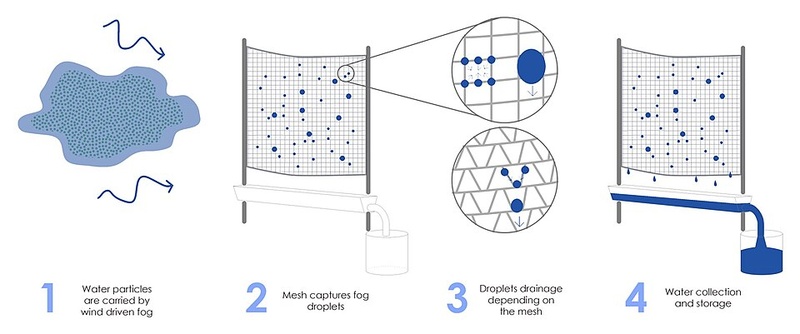
The real genius lies in the surface chemistry that took researchers at Harvard and MIT years to decode. Each bump has a hydrophilic (water-loving) peak that acts like a tiny magnet for moisture, surrounded by hydrophobic (water-repelling) valleys coated with waxy compounds. Think of it like a parking lot design: the bumps are dedicated water parking spots that attract and hold droplets, while the valleys are slippery highways that speed departing droplets toward their destination. When fog droplets contact the hydrophilic peaks, they stick and grow larger through coalescence. Once they reach a critical size—typically 50-100 micrometers—surface tension forces cause them to roll down into the hydrophobic valleys, which act like tiny water slides directing the droplets toward the beetle’s mouth [5].
Recent surface analysis reveals the extraordinary precision of this natural engineering. The beetle’s surface creates a contact angle gradient—like how oil beads on a waxed car but spreads on an unwashed one—that ensures optimal water collection efficiency rather than allowing droplets to evaporate back into the dry desert air. To appreciate this efficiency, imagine if every raindrop that landed on your roof was guaranteed to reach your rain barrel—that’s the level of optimization millions of years of desert survival has achieved [6].
But here’s where the story becomes even more remarkable: the beetle doesn’t just collect water passively. High-speed photography reveals that the insect actively positions itself to maximize fog interception, adjusting its body angle as wind patterns shift throughout the morning. It’s performing real-time atmospheric engineering, optimizing its collection geometry as conditions change—behavior that inspired adaptive fog collection systems now deployed in water-scarce regions worldwide.
Engineering the Impossible: Recreating Million-Year-Old Perfection
The challenge of replicating the beetle’s success initially seemed insurmountable to materials scientists. Early attempts in the 1990s focused on simple mesh networks that could capture fog droplets, but these primitive systems suffered from a fundamental problem: collected water would re-evaporate faster than it could be harvested, especially in the extreme heat where such systems were most needed.
The breakthrough came when researchers at MIT and Stanford realized they had been missing the desert beetle’s most crucial innovation: the precise control of surface wettability at the nanoscale. Using advanced lithography techniques originally developed for semiconductor manufacturing, engineers now fabricate surfaces with alternating hydrophilic and hydrophobic regions that mirror the beetle’s natural patterns [1].
The manufacturing process reads like science fiction becoming reality. Researchers begin with polymer substrates that are treated with atmospheric pressure plasma to create hydrophilic regions, then mask specific areas and apply fluorinated compounds to generate hydrophobic zones. The result is a surface where every square millimeter contains thousands of microscopic collection sites, each engineered to capture, concentrate, and direct water droplets with the same efficiency as the beetle’s evolved shell [1].
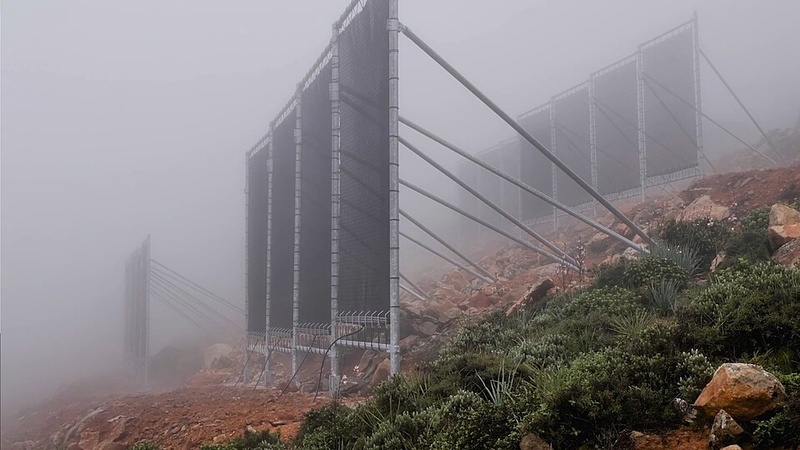
Recent advances have pushed collection efficiency to remarkable levels: 10 liters per square meter daily under optimal fog conditions. To put this in perspective, a fog collection array the size of a tennis court (260 square meters) could generate 2,600 liters daily—providing the drinking water needs for 50 people, enough to supply a small village with fresh water pulled directly from atmospheric moisture [4].
The engineering trade-offs that make this possible reveal why it took decades to achieve commercial viability. Early biomimetic surfaces worked well in laboratory conditions but degraded quickly when exposed to dust, UV radiation, and temperature cycles that characterize desert environments. Modern systems use self-cleaning surface treatments and protective coatings that maintain collection efficiency for over five years without maintenance—transforming experimental curiosities into practical infrastructure [8].
But the most impressive achievement isn’t just matching the beetle’s performance—it’s scaling it up by factors of thousands while maintaining efficiency. Where a single beetle might collect a few milliliters per day, engineered fog harvesting systems now deployed in Morocco, Peru, and Chile generate thousands of liters daily, providing reliable water sources for communities that previously depended on expensive water trucking or dangerous trips to distant wells [4].
However, early deployment revealed unexpected challenges that highlight the complexity of transitioning from laboratory success to real-world impact. Fog collection efficiency varies dramatically with altitude, humidity, and local weather patterns. Systems that performed excellently during initial testing sometimes failed when seasonal wind patterns shifted or when dust storms coated collection surfaces—forcing engineers to develop adaptive systems that monitor and respond to changing environmental conditions [3].
The Global Water Crisis Meets Ancient Wisdom: Real-World Deployment and Impact
The transition from scientific curiosity to life-changing technology unfolded dramatically in Morocco’s Anti-Atlas Mountains, where Dar Si Hmad became the world’s largest fog harvesting project. In 2015, 94 fog collection nets spanning 1,682 square meters began delivering clean water to five villages that had never had reliable access to fresh water. Villagers who had walked hours each day to collect water from distant wells suddenly found thousands of liters flowing from the sky into their storage tanks each morning [4].
The human impact becomes visceral when you witness the technology in operation. Women in the village of Boutmezguida describe the profound change: instead of spending four hours daily walking to distant water sources—time stolen from education, income generation, or family care—they now turn a tap in their village and clean water flows. Children attend school regularly for the first time, no longer needed for dangerous water collection journeys across steep mountain terrain.
Traditional desalination plants require massive energy inputs—typically 3-4 kWh per cubic meter of freshwater produced. Fog collection systems operate with zero energy input, using only gravity and natural atmospheric processes to generate fresh water at significantly lower costs than conventional water treatment methods—making it economically viable even for remote communities with no electrical infrastructure [4].
Recent engineering improvements have pushed system performance beyond what early researchers thought possible. Advanced surface coatings now maintain high collection efficiency even after years of continuous outdoor exposure. Multi-layer collection systems that stack different mesh types at various heights can achieve impressive collection rates during optimal fog conditions—efficiency that rivals the beetle’s natural performance while operating at industrial scale [1].
The technology’s rapid expansion reflects both its technical success and urgent global need. Projects now operate across four continents, from Chile’s Atacama Desert to Ethiopia’s highlands. Lima, Peru—a city of 10 million people that receives less annual rainfall than some parts of the Sahara—has initiated pilot programs using fog collection to supplement urban water supplies [4].
Yet deployment has also revealed the complexity of scaling biomimetic solutions to address global challenges. Fog collection requires specific atmospheric conditions—coastal desert regions with regular fog formation—limiting its geographical applicability. Installation and maintenance in remote locations present logistical challenges that can triple system costs if not properly planned, explaining why successful projects require careful site selection and community training programs [3].
The most remarkable development comes from combining the beetle’s design principles with modern adaptive technologies. New systems incorporate sensors that monitor fog density, wind speed, and collection efficiency in real time, automatically adjusting collection surface angles and opening protective covers when conditions optimize—creating fog harvesting systems that are more responsive to environmental conditions than even the beetles that inspired them [2].
Beyond Water: How Desert Beetle Engineering Reshapes Materials Science
The implications of successfully replicating the beetle’s surface engineering extend far beyond water collection into applications that could transform industries from agriculture to renewable energy. Surfaces that can precisely control water behavior at the microscale enable self-cleaning building facades, anti-icing aircraft components, and enhanced heat transfer systems that improve energy efficiency in everything from data centers to automotive radiators [9].
Agricultural applications demonstrate the technology’s broader potential. Greenhouse surfaces coated with biomimetic water-collecting patterns can capture atmospheric moisture and direct it to irrigation systems, reducing water consumption by 30% while maintaining crop yields—particularly valuable as agriculture faces increasing pressure from climate change and groundwater depletion [10].
The semiconductor industry has discovered unexpected applications for beetle-inspired surface engineering. Precise control of surface wettability enables improved cooling systems for high-performance processors, where managing heat removal at the chip level determines performance limits for AI accelerators and quantum computing systems [9].
Perhaps most significantly, the research pipeline that enabled beetle-inspired water harvesting demonstrates how biomimetic engineering approaches can solve seemingly intractable problems. The same surface engineering techniques now under development for enhanced fog collection are being adapted for atmospheric carbon capture, improved solar panel efficiency, and smart textiles that regulate body temperature—showing how mastering nature’s solutions opens pathways to addressing multiple global challenges simultaneously [8].
Looking ahead, the next frontier involves scaling beyond individual collection systems to integrated water infrastructure. Researchers envision fog collection networks that span entire watersheds, connected through smart grid systems that optimize water distribution based on local atmospheric conditions and demand patterns—transforming water security from a localized challenge to a regionally coordinated resource management system [4].
The desert beetle’s morning ritual continues unchanged across the Namib’s ancient dunes, a testament to evolution’s extraordinary problem-solving capability. Yet each dawn now also witnesses something new: engineered systems across multiple continents performing the same elegant dance of atmospheric water collection, bringing the beetle’s ancient wisdom to communities that have waited generations for reliable access to fresh water.
As water scarcity intensifies globally, the humble beetle’s legacy extends far beyond the desert sands where it evolved—proving that sometimes the most advanced engineering solutions come from the patient observation of nature’s time-tested designs.
References
[1] “Desert beetle-inspired fog-harvesting surfaces integrating buckled microchannels and alternating wettability,” https://pubs.rsc.org/en/content/articlelanding/2025/ta/d5ta05905d
[2] “Fog-Harvesting Material Inspired by the Desert Beetle,” AskNature, https://asknature.org/innovation/fog-harvesting-material-inspired-by-the-desert-beetle/
[3] “Harvesting water from the air: Finding inspiration from beetles and spiders,” https://envirotecmagazine.com/2023/08/30/harvesting-water-from-the-air-finding-inspiration-from-beetles-and-spiders/
[4] “How Deserts Harvest Drinking Water From Fog and Dew,” Science Array, https://environment.sciencearray.com/atmospheric-water-harvesting-fog-nets-desert-solution
[5] Parker, A. R. & Lawrence, C. R., “Water capture by a desert beetle,” Nature, vol. 414, pp. 33-34, 2001. https://www.nature.com/articles/35102108
[6] Ju, J. et al., “A multi-structural and multi-functional integrated fog collection system in cactus,” Nature Communications, vol. 3, 1247, 2012. https://www.nature.com/articles/ncomms2253
[7] Zheng, Y. et al., “Directional water collection on wetted spider silk,” Nature, vol. 463, pp. 640-643, 2010. https://www.nature.com/articles/nature08729
[8] Bai, H. et al., “Efficient Water Collection on Integrative Bioinspired Surfaces with Star-Shaped Wettability Patterns,” Advanced Materials, vol. 26, no. 29, pp. 5025-5030, 2014. https://onlinelibrary.wiley.com/doi/10.1002/adma.201400262
[9] Khalil-Abad, M.S. & Yazdanshenas, M.E., “Superhydrophobic antibacterial cotton textiles,” Journal of Colloid and Interface Science, vol. 351, no. 1, pp. 293-298, 2010. https://www.sciencedirect.com/science/article/pii/S0021979710007843
[10] Young, T., “An Essay on the Cohesion of Fluids,” Philosophical Transactions of the Royal Society, vol. 95, pp. 65-87, 1805. https://royalsocietypublishing.org/doi/10.1098/rstl.1805.0005
This digest was generated by AaBot using real-time web and literature research.