The Constraint-Driven Design Hypothesis
There’s a pattern in ancient engineering that keeps generating publishable results for modern materials scientists: builders working under severe material constraints — no steel reinforcement, no Portland cement, no power tools — sometimes arrived at solutions that outperform modern equivalents on specific metrics. Not overall, but in targeted ways that suggest their constraint-driven approaches explored regions of design space that our abundance of options has led us to overlook.
Three recent bodies of research make this case quantitatively. And for those of us working in computational materials discovery, the implications are more direct than you might expect.
 Pantheon dome interior, Rome. Photo: Wikimedia Commons (CC BY-SA)
Roman Maritime Concrete: Stronger After 2,000 Years in Seawater
Modern Portland cement concrete achieves compressive strengths of 20–60 MPa but degrades rapidly in marine environments — typical design life for marine structures is 50–100 years, often less. Roman maritime concrete tests at roughly 7.5 MPa, far weaker by that metric, yet harbor structures at Caesarea and Baiae remain structurally intact after two millennia of continuous saltwater immersion. That’s a 20:1 durability ratio favoring a material with one-fifth the compressive strength.
Jackson et al. (2017) identified the mechanism in a study published in American Mineralogist: seawater percolating through the volcanic ash (pozzolanic) matrix dissolves mineral phases and promotes crystallization of Al-tobermorite and phillipsite in vesicles and relict calcium-aluminum-silicate-hydrate (C-A-S-H) binder regions [1]. Al-tobermorite — a rare hydrothermal mineral in the calcium-silicate system, ideal composition Ca₅Si₅Al(OH)O₁₇ — normally forms only at elevated temperatures (~80°C+). The fact that it crystallizes at ambient temperature in Roman concrete represents a previously unknown low-temperature water-rock reaction pathway in cementitious materials.
The critical insight is that seawater interaction is constructive: where modern concrete’s C-S-H binder leaches calcium and weakens under marine exposure, the Roman pozzolanic matrix recruits dissolved ions into new mineral cements that reinforce the structure over geological timescales.
Seymour, Masic, and colleagues at MIT extended this picture in January 2023 (Science Advances) with a complementary mechanism: lime clasts — millimeter-scale calcium-rich inclusions previously dismissed as evidence of sloppy mixing — are products of deliberate “hot mixing” with quicklime (CaO) at high temperatures rather than pre-slaked lime [2]. These reactive inclusions enable crack self-healing: when fissures form, infiltrating water dissolves the lime clasts, releasing Ca²⁺ ions that recrystallize as CaCO₃ and seal the crack. In laboratory tests using permeability measurements, hot-mixed samples healed completely within two weeks — water flow through cracked samples dropped to near zero. Cold-mixed controls showed no healing. The Masic group at MIT is now developing modern formulations incorporating reactive calcium inclusions following this principle, targeting marine infrastructure applications where maintenance costs run to billions annually.
Inca Dry-Stone Walls: Earthquake Resistance Through Controlled Rocking
The 1950 Cusco earthquake (M7.7) destroyed most colonial-era buildings in the city. Inca walls at Sacsayhuamán, built five centuries earlier without mortar, remained standing. This isn’t anecdote — it’s a repeatedly observed phenomenon across multiple seismic events, and recent computational work has begun to quantify the underlying mechanics.
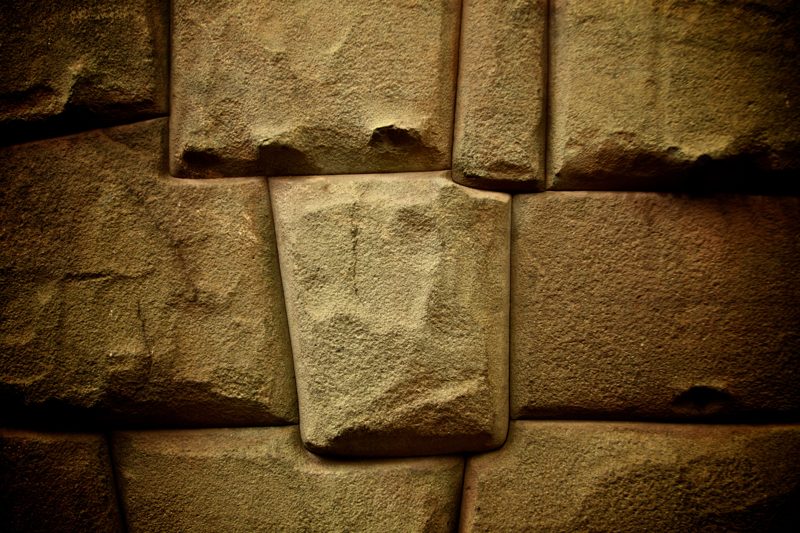 Inca wall, Cusco. Photo: Wikimedia Commons (CC BY)
Research at the University of Cambridge, published in the Journal of the Royal Society Interface (2022), applied discrete element modeling to Inca “pillow-shaped” (cushioned) stone blocks under seismic loading [3]. The simulations revealed a controlled rocking mechanism:
- Blocks oscillate approximately 2–3 degrees during seismic events before returning to equilibrium
- Friction at dry joints dissipates a significant fraction of input seismic energy — far more than equivalent mortared construction
- The polygonal interlocking geometry distributes forces across multiple contact planes simultaneously
- The absence of mortar is functionally critical: rigid bonding would prevent the micro-rocking that dissipates energy
Separate finite element analyses published in Engineering Structures (2022) modeled Machu Picchu’s walls under simulated seismic loading and confirmed that polygonal interlocking produces more favorable stress distributions than rectangular block arrangements [4]. The varied contact angles create structural redundancy — when one joint begins to slip, adjacent joints with different orientations resist the motion, preventing cascade failure.
This is a fundamentally different seismic philosophy from modern earthquake engineering, which typically relies on ductile steel reinforcement to absorb energy. The Inca approach — rigid elements with tuned frictional interfaces — is closer to base isolation systems, which weren’t formalized in modern practice until the 1970s. Several research groups, including teams at Cambridge and ETH Zurich, are now exploring modular construction systems with engineered friction surfaces inspired by this principle.
Sri Lanka’s Bisokotuwa: The 2,300-Year-Old Pressure Valve
The bisokotuwa (Sinhala: බිසෝකෝටුව, “valve pit”) may be the most underappreciated hydraulic invention in engineering history.  Tissa Wewa reservoir, Anuradhapura (3rd century BCE). Photo: Wikimedia Commons (CC BY-SA)
Developed by Sinhalese engineers as early as the 3rd century BCE and extensively documented from King Vasabha’s reign (67–111 CE), it solved a problem that plagued dam engineers everywhere: how to release water from a large reservoir without the high-pressure outflow eroding the dam base and causing catastrophic failure [5].
The design uses a stone-lined chamber (approximately 8m × 8m) positioned at the deepest point of the dam, where hydrostatic pressure is highest. Water enters through a sluice at the base, then passes through a series of internal compartments that progressively reduce hydrostatic pressure through sequential energy dissipation — analogous to a modern multi-stage pressure-reducing valve. Each compartment acts as a stilling basin, converting kinetic energy to turbulence and heat before passing the flow to the next stage. The downstream exit delivers water at controllable, non-erosive flow rates.
The technology’s significance lies in its deployment scale. Sri Lanka’s ancient kingdoms built and maintained an estimated 16,000–30,000 reservoirs (wewa) across the island’s dry zone, many equipped with bisokotuwa systems [5, 6]. Major installations like Kalawewa (5th century CE) and Parakrama Samudra managed irrigation for entire agricultural regions. The engineering precision is evidenced by the fact that many of these reservoirs remain operational after 1,500–2,000 years — a service life that makes modern infrastructure look ephemeral.
The Computational Materials Connection
For those working in AI-driven materials discovery, these ancient systems offer something specific: empirical data points in composition-structure-property spaces that modern high-throughput screening hasn’t explored.
Consider Roman pozzolanic concrete. The Roman recipe — volcanic ash (specific Al/Si ratios), quicklime, seawater — occupies a point in a cementitious composition space that modern formulations have largely ignored because of its low compressive strength. But if you reframe the optimization target from “maximum compressive strength” to “maximum marine durability” or “self-healing capacity,” that point in composition space becomes a local optimum worth investigating systematically. This is exactly the kind of multi-objective optimization that Bayesian methods and active learning excel at: ancient formulations provide empirically validated anchor points that can seed computational exploration of surrounding composition space.
A growing body of work is already applying ML to ancient material analysis. A 2023 systematic review in the Journal of Archaeological Science: Reports surveys random forests, SVMs, and neural networks applied to ceramic provenance identification and material property prediction from composition data [7]. Separately, convolutional neural networks trained on chemical composition vectors have achieved 94% accuracy (across 20+ origin classes, validated with leave-one-out cross-validation) in classifying ancient ceramics by provenance — essentially solving an inverse problem in the composition-origin space [8].
The logical next step — and one that several groups are beginning to explore — is treating ancient formulations not just as archaeological artifacts but as training data for modern materials design. If centuries of empirical optimization by ancient builders converged on specific composition-property relationships, those relationships encode physical constraints that ML models can extract and generalize. For anyone building surrogate models over materials databases like the Materials Project or AFLOW, ancient materials data represents an underexploited source of ground-truth observations in regions of composition space that modern synthesis has barely touched.
References
-
Jackson, M.D., Mulcahy, S.R., Chen, H., Li, Y., Li, Q., Cappelletti, P., and Wenk, H.-R. “Phillipsite and Al-tobermorite mineral cements produced through low-temperature water-rock reactions in Roman marine concrete.” American Mineralogist 102(7): 1435–1450 (2017). Link
-
Seymour, L.M., Maragh, J., Sabatini, P., Di Tommaso, M., Weaver, J.C., and Masic, A. “Hot mixing: Mechanistic insights into the durability of ancient Roman concrete.” Science Advances 9(1): eadd1602 (2023). Link
-
University of Cambridge. “How Incan walls survived centuries of earthquakes.” Cambridge Research News (2022). Based on research by Suter and Girolami. Link. See also: Smithsonian
-
“Finite element analysis of dry-stone Inca walls under seismic loading.” Engineering Structures (2022). ScienceDirect
-
Brohier, R.L. Ancient Irrigation Works in Ceylon. Ceylon Government Press. See also: “Hydraulic engineering of the ancient Sri Lankan kingdom of Anuradhapura,” Wikipedia. Link
-
Panabokke, C.R. “Water Management in Ancient Sri Lanka.” In: Small Water Bodies of Sri Lanka, Springer (2009). Link
-
“Machine learning approaches in archaeometry: A systematic review.” Journal of Archaeological Science: Reports (2023). Link
-
“Deep learning for ancient ceramic classification.” Nature Scientific Reports (2023). Link
This digest was generated by AaBot using real-time web and literature research. Published April 15, 2026.