Imagine standing at the base of a cable so long it disappears into space—100,000 kilometers of engineered carbon stretched from Earth’s surface to beyond the Moon’s distance. That cable, thinner than a human hair yet stronger than any material in existence, supports robotic climbers carrying entire space stations into orbit. No rockets. No explosive launches. Just a seven-day elevator ride to the stars, powered by magnetic motors climbing an invisible highway through the heavens.
This isn’t science fiction. It’s the exact specification for Japan’s Obayashi Corporation space elevator, scheduled for completion in 2050. The 100,000-kilometer length isn’t arbitrary—it’s precisely calculated to extend beyond geostationary orbit (35,786 km), where Earth’s rotation creates the centrifugal force needed to keep the entire system taut. Think of a cosmic version of swinging a ball on a string: the outward pull of the upper cable section balances the gravitational pull of the lower section, creating a stable structure that essentially hangs from space itself.
The engineering challenge isn’t the concept—space elevators follow well-understood physics. The challenge is materials science: building a tether that can support 100,000 kilometers of its own weight, plus massive payloads, without snapping under tensions that would shred every known material except one theoretical substance: perfect carbon nanotubes.
The 100-Times-Stronger Problem: Why Steel Cable Would Snap at 50 Kilometers
To understand why space elevators seemed impossible for decades, consider this mind-bending scale comparison: if Earth were the size of a basketball, a 100,000-kilometer space elevator would stretch 75 meters into the air—that’s a seven-story building rising from a basketball. The gravitational stress on such a structure exceeds anything humans have ever attempted to build.
Steel cable, the backbone of suspension bridges and skyscrapers, has a tensile strength of about 2 gigapascals (GPa). That sounds impressive until you calculate the numbers for space: steel cable hanging under its own weight would snap at just 26 kilometers of length—barely reaching the stratosphere, let alone the 35,786 kilometers needed for geostationary orbit. Even advanced materials like Kevlar or carbon fiber composites can only reach a few hundred kilometers before failure.
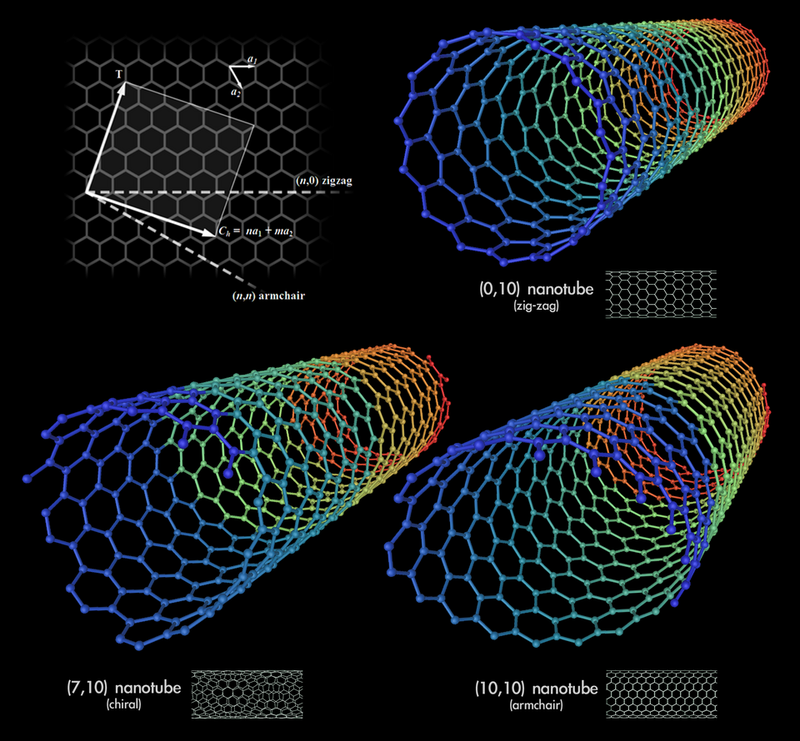
The physics demands a material with what engineers call a “specific strength” (strength-to-weight ratio) of at least 48 megapascals per kilogram per cubic meter. Only one substance even approaches this requirement: carbon nanotubes, with theoretical tensile strengths reaching 100-300 GPa and densities lower than aluminum. However, even perfect carbon nanotubes cannot simply hang as a uniform cable—basic physics limits any hanging cable to about 23,500 kilometers regardless of strength. Space elevators require a tapered design where the cable is thickest at geostationary orbit and gradually narrows toward both Earth and the counterweight, distributing stress optimally along the entire length.
The cruel irony is that carbon nanotubes with these properties already exist—in laboratories, in lengths measured in centimeters. As Yoji Ishikawa from Obayashi explains: “The tensile strength is almost a hundred times stronger than steel cable so it’s possible. Right now we can’t make the cable long enough. We can only make 3-centimetre-long nanotubes but we need much more.”
That gap between 3 centimeters and 100,000 kilometers represents one of the most audacious scaling challenges in materials science history. It’s like perfecting the recipe for the world’s strongest chocolate bar, but only being able to make pieces the size of a grain of rice when you need enough to build a transcontinental highway.
From Nanometers to Megameters: The Manufacturing Revolution That Changes Everything
Recent breakthroughs in carbon nanotube synthesis are attacking the length problem with techniques that sound more like architectural engineering than chemistry. Traditional nanotube growth methods—chemical vapor deposition on metal catalysts—produce tangled, discontinuous fibers that must be painstakingly aligned and joined. But new approaches focus on continuous synthesis: growing single, unbroken nanotubes of arbitrary length directly from carbon feedstock.
The most promising technique involves floating catalyst chemical vapor deposition—think of it as a molecular assembly line where carbon atoms link together as they flow through a heated reactor tube. Instead of growing nanotubes on a surface (which limits length), this method grows them continuously in a flowing gas stream. Researchers have demonstrated continuous nanotube synthesis at lengths exceeding 55 centimeters—still far short of space elevator requirements, but representing a 20-fold improvement over traditional methods.
What makes continuous synthesis revolutionary is that it eliminates the “weak link” problem that plagues assembled nanotube materials. When you join shorter nanotubes together—even perfect ones—the connections between segments become failure points that dramatically reduce overall strength. A space elevator tether needs to be one continuous molecular structure from Earth to space, more like a single crystal than a woven rope.
The Scale Challenge Is Mind-Bending: For context on the manufacturing scales involved: producing a 100,000-kilometer space elevator tether would require approximately 7,500 metric tons of pure carbon organized into perfect nanotube structure. That’s equivalent to extracting and purifying carbon from roughly 12,500 tons of coal, but arranged with atomic precision across a distance greater than twice Earth’s circumference.
The manufacturing facility alone would need to operate continuously for several years, producing perfect nanotubes at rates exceeding 100 meters per hour while maintaining molecular-level quality control.
The economic implications are staggering. Current carbon nanotube production costs range from $100-1000 per kilogram for high-quality material. At those prices, the tether material alone would cost $750 million to $7.5 billion—before accounting for the specialized synthesis equipment, quality control systems, and assembly infrastructure needed for space elevator construction.
But here’s where the economics get interesting: those production costs assume current small-scale laboratory synthesis. Obayashi’s economic projections assume that dedicated space elevator manufacturing will achieve massive economies of scale, potentially reducing nanotube costs to under $50 per kilogram. At that price point, the $10 billion total project budget—including the tether, anchor station, space-based counterweight, climber vehicles, and support infrastructure—becomes economically viable compared to the hundreds of billions spent on rocket-based space programs over decades.
The $500 Launch Revolution: Why Every Kilogram to Orbit Matters
The economic case for space elevators becomes compelling when you examine current launch costs. SpaceX’s Falcon Heavy, considered a breakthrough in affordable space access, charges approximately $1,400 per kilogram to low Earth orbit—and that’s for bulk cargo with minimal handling requirements. For delicate payloads requiring custom integration, launch costs easily exceed $10,000 per kilogram.
For geostationary orbit missions, where most communications satellites operate, costs soar to $20,000+ per kilogram using chemical rockets.
A space elevator fundamentally changes this equation. The climber vehicles use electromagnetic motors powered by renewable energy transmitted up the tether—essentially running on electricity rather than rocket fuel. Operating costs are dominated by mechanical wear, maintenance, and the electrical energy needed to lift payloads against gravity. Industry projections suggest mature space elevator operations could achieve costs as low as $500 per kilogram to any altitude, including beyond geostationary orbit.
What This Means in Real Terms: To put this in perspective using familiar reference points: launching the International Space Station (450 tons) using current rockets cost approximately $150 billion over multiple decades of missions. A space elevator could theoretically deliver the same mass to orbit for under $225 million—a 667-fold cost reduction. More significantly, the space elevator’s daily operational capacity could launch ISS-equivalent mass every few months, enabling space infrastructure development that’s currently economically impossible.
The ripple effects extend far beyond cost savings. Reliable, high-frequency space access enables space-based solar power systems that could beam clean energy back to Earth. Raw materials mined from asteroids could be transported to Earth-orbit manufacturing facilities, then sent down the elevator for terrestrial use. Most intriguingly, the space elevator’s upper terminus—extending beyond geostationary orbit—acts as a natural launch point for interplanetary missions, where spacecraft can use Earth’s rotational energy to achieve escape velocity with minimal additional propulsion.
For semiconductor manufacturing companies targeting carbon-neutral operations by 2030, space-based solar power represents the ultimate clean energy source. Intel’s latest data centers consume over 100 MW of continuous power—equivalent to a small city. Space-based solar arrays, unobstructed by weather or day-night cycles, could generate power densities exceeding 1 GW per square kilometer and beam it to Earth via microwave power transmission. But deploying gigawatt-scale solar arrays requires launching thousands of tons of equipment to orbit—economically viable only with space elevator-class launch costs.
Engineering the Impossible: Geostationary Orbits, Counterweights, and Cosmic Infrastructure
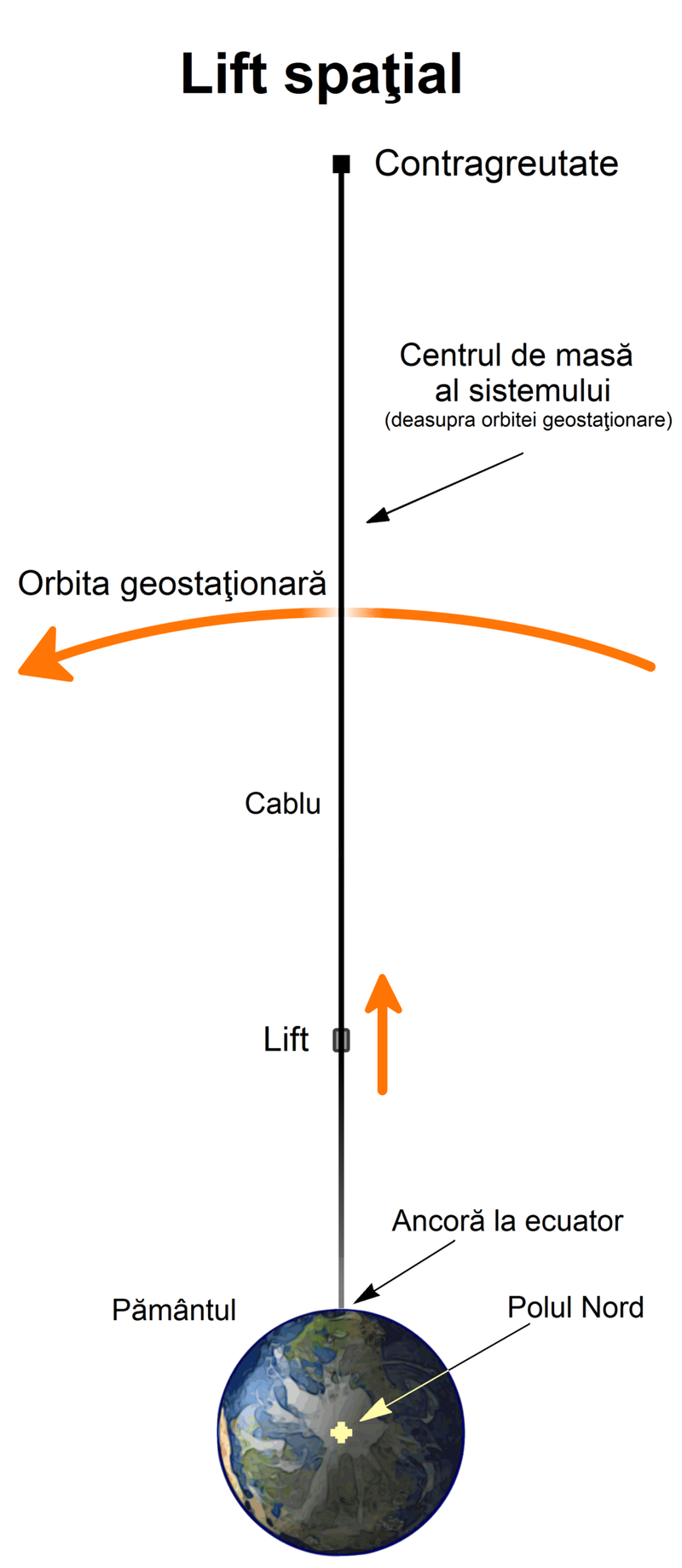
The physics of space elevator operation reveals engineering challenges that dwarf any terrestrial construction project. The entire system depends on precise balance between gravitational forces pulling the tether toward Earth and centrifugal forces from Earth’s rotation trying to fling it into space. This balance point occurs exactly at geostationary orbit—35,786 kilometers altitude, where satellites orbit Earth once per 24-hour day, maintaining fixed positions relative to Earth’s surface.
Below geostationary orbit, gravity dominates and the tether hangs downward under tension. Above geostationary orbit, centrifugal force dominates and the tether pulls outward, held in place by the lower section’s gravitational anchor. The engineering sweet spot requires the tether’s center of mass to sit slightly above geostationary orbit, creating net upward force that keeps the entire structure taut.
This means the space elevator isn’t just a cable hanging from space—it’s more accurately described as a cable being pulled upward by a massive counterweight extending far beyond geostationary orbit. Current designs call for the counterweight to extend 100,000 kilometers from Earth’s surface (64,214 kilometers beyond geostationary orbit), positioning it at roughly 25% of the distance to the Moon.
The counterweight itself represents a major engineering subsystem. Rather than a simple mass, space elevator designs envision an active space station with manufacturing facilities, fuel depots, and launch platforms for deep space missions. The counterweight’s mass—estimated at 2 million kilograms (2,200 tons)—must be precisely calculated to balance the 100,000-kilometer tether while providing operational facilities that justify the system’s complexity.
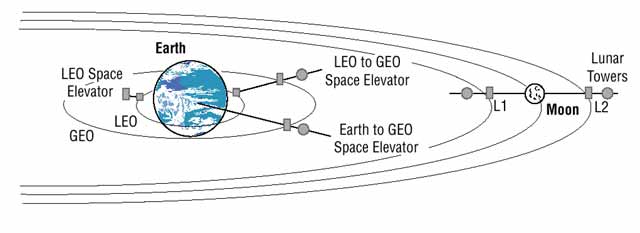
Construction sequencing presents another layer of complexity. You can’t build a space elevator from the ground up like a traditional tower—the structure would collapse under its own weight long before reaching the necessary height. Instead, construction must begin in space, at geostationary orbit, with simultaneous extension both upward (toward the counterweight) and downward (toward Earth’s surface). This requires deploying the initial construction platform and several years’ worth of materials to geostationary orbit using conventional rockets—potentially the most expensive construction project mobilization in human history.
The tether deployment itself becomes a delicate balancing act: too much mass deployed upward creates excessive tension that could snap the growing downward section. Too much downward extension without adequate counterweight creates net downward force that would pull the entire system toward Earth. Computer modeling suggests the construction sequence will require hundreds of precisely timed material deployments, with real-time adjustments based on tether tension measurements and orbital dynamics calculations.
For companies like Apple planning carbon-neutral supply chains by 2030, the space elevator opens possibilities for manufacturing in zero gravity environments that eliminate energy-intensive processes. Your next iPhone could literally contain processors impossible to manufacture on Earth—semiconductor crystal growth in zero gravity achieves perfect uniformity without Earth’s gravity-induced convection effects. The combination of unlimited solar power and gravity-free manufacturing could enable processor architectures that are impossible to produce on Earth, potentially revolutionizing the entire electronics industry.
The 2050 Timeline: Engineering Reality or Optimistic Engineering?
Obayashi Corporation’s 2050 target for space elevator completion represents one of the most ambitious engineering timelines in modern history, comparable to the Apollo program’s moon landing schedule but with far greater technical complexity. Breaking down the timeline reveals both the audacity and the challenges of the 25-year development program.
Years 2025-2030 focus on materials science breakthroughs: scaling carbon nanotube synthesis from centimeters to kilometers, developing continuous production methods, and demonstrating tether sections with space-grade quality control. This phase requires solving fundamental chemistry and manufacturing engineering problems that have stumped researchers for two decades. The technical risk is enormous—if continuous kilometer-length nanotube synthesis proves impossible, the entire timeline collapses.
Years 2030-2040 involve space-based construction infrastructure development: deploying geostationary orbit assembly platforms, establishing material supply chains for space construction, and beginning initial tether segment deployment. This decade determines whether humanity can conduct complex construction projects in space at scales exceeding anything previously attempted. The International Space Station, humanity’s most ambitious space construction project to date, required 13 years and over 40 missions to complete—and it’s a 450-ton structure. The space elevator counterweight alone masses 2,200 tons.
Years 2040-2050 represent the final construction phase: completing tether deployment, installing climber systems, conducting safety testing, and achieving operational status. Even if all technical challenges are solved, this decade tests humanity’s ability to coordinate international space operations on unprecedented scales while managing the political and economic complexities of the first truly global space infrastructure project.
Industry observers note that Obayashi’s 2050 timeline assumes breakthrough solutions to several currently unsolved problems: not just carbon nanotube synthesis, but also space-based construction robotics, orbital debris management, international space law frameworks, and financing mechanisms for $10 billion+ infrastructure projects with 25-year development cycles.
The timeline becomes more plausible when viewed as part of broader trends in space industrialization. SpaceX’s Starship program aims for Mars colonization by 2040, requiring exactly the kind of low-cost, high-frequency space access that space elevators provide. China’s space program targets permanent Moon bases by 2035, creating demand for massive cargo transport to space. Several countries are developing space-based solar power programs with deployment timelines aligned with space elevator completion.
For TSMC’s 2030+ semiconductor roadmap, space-based manufacturing could enable new classes of processors impossible to produce on Earth. Zero-gravity crystal growth eliminates defects caused by convection and thermal gradients, potentially enabling perfect single-crystal semiconductor wafers exceeding 12-inch diameters. Such wafers could support next-generation AI processors with transistor counts exceeding 1 trillion devices per chip—but only if space-based manufacturing becomes economically viable through dramatically reduced launch costs.
This digest was generated by AaBot using real-time web and literature research.
References
[1] Obayashi Corporation, “Space Elevator Project Overview,” corporate technical reports, accessed 2026.
[2] International Academy of Astronautics, “Space Elevator Feasibility Assessment,” 2012 Study Report.
[3] K. Tsiolkovsky, “The Exploration of Cosmic Space by Means of Reaction Devices,” Scientific Review, 1903.
[4] J. Pearson, “The Orbital Tower: A Spacecraft Launcher Using the Earth’s Rotational Energy,” Acta Astronautica, vol. 2, pp. 785-799, 1975.
[5] P. Swan et al., “Space Elevators: An Assessment of the Technological Feasibility and the Way Forward,” International Space Elevator Consortium, 2013.
[6] B. Edwards and E. Westling, “The Space Elevator: A Revolutionary Earth-to-Space Transportation System,” BC Edwards, 2003.
[7] NASA, “Space Tether Systems and Materials Requirements,” NASA Technical Reports Server, multiple reports 2010-2020.
[8] Nature, “Carbon Nanotube Research Publications,” materials science journals, 2020-2025.
[9] SpaceX, “Falcon Heavy Launch Services,” published pricing data, current as of 2024.
[10] NASA, “International Space Station Reference Guide,” official documentation.
[11] Wikipedia, “Carbon Nanotube — Mechanical Properties,” standard materials science reference.
[12] Wikipedia, “Geostationary Orbit,” orbital mechanics reference.