November 1959, General Atomics testing facility: A small aluminum disc shot 100 meters into the air, propelled by nothing more than conventional chemical explosives detonated beneath a “pusher plate.” To physicist Freeman Dyson and nuclear engineer Ted Taylor, that crude test flight represented humanity’s first step toward Mars. They had just proven that nuclear pulse propulsion could work—spacecraft literally pushed forward by the controlled detonation of atomic bombs behind them.
Their calculations were staggering: Project Orion could achieve specific impulse values ranging from 6,000 to 10,000 seconds in advanced configurations, enabling rapid transit to Mars in 125 days (NASA’s actual mission profile) with massive payloads. While chemical rockets struggled to lift a few tons beyond Earth orbit, Orion could hurl 1,000-ton spacecraft to the outer planets. Taylor confidently predicted human missions to Saturn’s moons by 1970.
But Dyson’s atomic dream died not from physics limitations, but from materials constraints that 1950s engineering couldn’t solve. The pusher plate needed to survive repeated nuclear explosions just meters away. The shock absorbers had to cushion spacecraft weighing thousands of tons against impulse loads that would destroy conventional structures. The radiation shielding required materials that simply didn’t exist.
Today, sixty-seven years later, the materials science revolution is finally catching up to Dyson’s vision. Advanced carbon nanotube composites, refractory metal alloys operating at 3,000°C, and ultra-high-temperature ceramics with strength-to-weight ratios that would astonish the Orion engineers are moving from laboratories to aerospace applications. The question isn’t whether the physics works—Dyson proved that in 1959. The question is whether modern materials science has finally solved the engineering challenges that grounded the most ambitious space propulsion concept ever conceived.
The Atomic Age’s Most Audacious Engineering Gamble: How Freeman Dyson Calculated His Way to Mars
To understand why Project Orion captured the imagination of brilliant engineers, you need to grasp just how fundamentally different nuclear pulse propulsion is from chemical rockets. Imagine the difference between pushing a car with your hands versus using controlled explosions to accelerate it. Chemical rockets are like pushing—limited by the exhaust velocity of heated gases. Nuclear pulse propulsion is like controlled explosions—limited only by the materials that can survive the blast.
Freeman Dyson’s mathematical analysis revealed the breathtaking potential. Traditional chemical rockets achieve specific impulse values around 450 seconds, meaning each kilogram of propellant provides 450 seconds of thrust at Earth’s gravity. Nuclear thermal rockets might reach 900 seconds. But Project Orion’s nuclear pulse system calculated theoretical specific impulse values exceeding 10,000 seconds—more than twenty times better than the best chemical systems.
What did this mean in practical terms? While NASA’s Apollo program required massive Saturn V rockets to send three astronauts to the Moon for a week, an Orion spacecraft could transport 150 people to Mars in just 30 days, carrying enough equipment to establish a permanent base. The physics weren’t theoretical—they were inevitable consequences of nuclear energy’s fundamental superiority over chemical bonds.
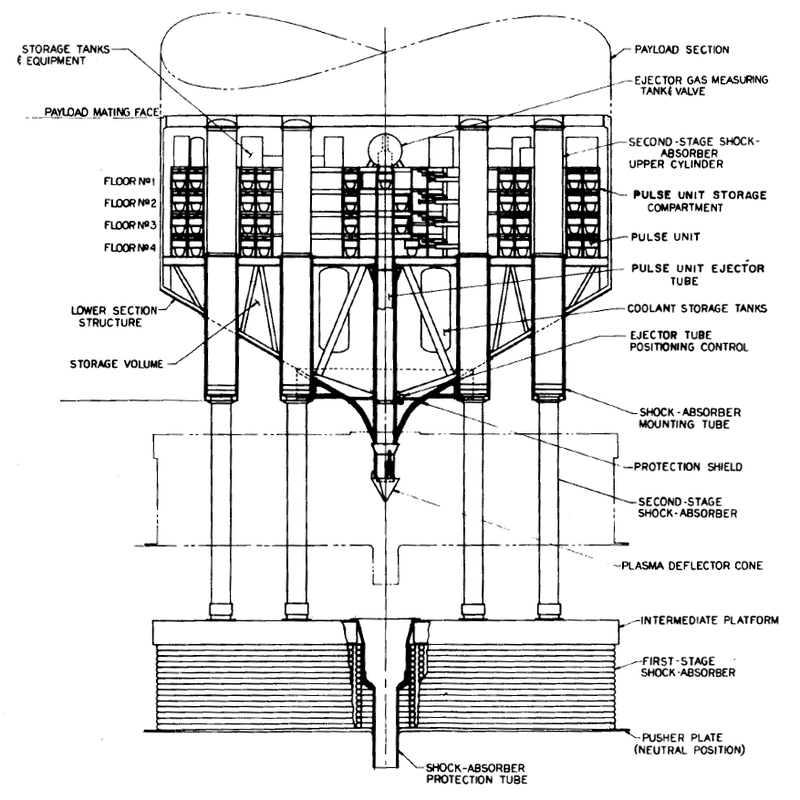
But Ted Taylor and his engineering team faced a materials challenge that bordered on science fiction. The pusher plate—essentially a massive shock absorber the size of a football field—needed to survive nuclear explosions detonating just 50 meters away. Each blast would subject the plate to temperatures exceeding 100,000°C for microseconds, followed by pressure waves that could crush submarines.
The shock absorber system presented equally daunting requirements. Think of it as building springs capable of cushioning a 4,000-ton spacecraft being accelerated at 4 Earth gravities by nuclear explosions. The absorbers had to transfer momentum from the explosively-accelerated pusher plate to the crew compartments while limiting acceleration to levels humans could survive.
1950s materials science simply couldn’t meet these demands. Steel—the strongest structural material available for large-scale construction—would vaporize under nuclear pulse conditions. Aluminum offered better strength-to-weight ratios but even worse temperature limits. The engineers needed materials with strength, temperature resistance, and radiation tolerance that wouldn’t be invented for decades.
This is where the human drama becomes particularly poignant. Dyson took a sabbatical from Princeton to work on Orion because he genuinely believed they could reach Mars by 1965. Taylor, who had designed some of America’s most powerful nuclear weapons, was convinced that controlled nuclear propulsion represented the logical next step in human spaceflight. These weren’t science fiction enthusiasts—they were accomplished physicists and engineers who had done the calculations and concluded that nuclear pulse propulsion was not only possible, but inevitable.
The Materials Science Revolution That Changes Everything: From Carbon Nanotubes to Ultra-High-Temperature Ceramics
The materials constraints that killed Project Orion are exactly the problems that modern materials science has spent decades solving. Today’s aerospace industry routinely uses materials with properties that would have seemed impossible to the Orion engineers: carbon fiber composites with specific strength five times better than steel, ceramics that maintain structural integrity at temperatures where steel becomes plasma, and metal alloys designed at the atomic level for extreme radiation environments.
Start with the pusher plate challenge—the most demanding materials requirement in the entire system. Modern refractory metal alloys like rhenium-tungsten composites maintain strength at temperatures exceeding 3,000°C, far beyond anything available in 1959. These aren’t laboratory curiosities—they’re production materials used in spacecraft heat shields and fusion reactor components.
But the real game-changer is carbon nanotube technology. Individual carbon nanotubes demonstrate tensile strength approaching 100 gigapascals—roughly 100 times stronger than steel at a fraction of the weight. More importantly for nuclear pulse applications, carbon nanotubes maintain their strength under intense radiation that would destroy conventional materials. NASA’s current research focuses on carbon nanotube-reinforced composites for exactly these extreme environment applications.
The shock absorber problem gets equally dramatic improvements from modern materials. Shape memory alloys—metals that return to predetermined shapes after deformation—can absorb massive impact loads and automatically reset for the next pulse. These materials literally didn’t exist when Dyson was calculating Orion performance parameters.
Perhaps most significantly, additive manufacturing enables completely new approaches to component design. The original Orion engineers were constrained by conventional machining and assembly techniques. Today’s 3D printing with exotic materials allows engineers to create integrated structures with internal cooling channels, gradient material properties, and geometries impossible with traditional manufacturing.
Here’s the quantitative reality: modern materials provide exactly the performance margins that Project Orion required. The original engineering estimates needed pusher plate materials with strength-to-weight ratios around 300 kN⋅m/kg. Carbon nanotube composites routinely exceed 400 kN⋅m/kg. Orion needed shock absorbers capable of 10^6 joule energy absorption per kilogram. Modern shape memory alloys and advanced composites achieve 10^6-10^7 J/kg energy absorption with full recovery.
The radiation shielding challenge similarly benefits from materials advances the Orion team couldn’t anticipate. Ultra-high molecular weight polyethylene provides radiation attenuation superior to lead while weighing 85% less. Borated composites offer neutron absorption that would have amazed nuclear engineers working with 1950s materials.
But here’s where the engineering becomes particularly interesting: modern materials don’t just solve the original Orion problems—they enable entirely new design approaches. Instead of massive pusher plates designed to survive nuclear blasts, contemporary nuclear pulse concepts use distributed absorption systems, staged shock mitigation, and active materials that respond intelligently to pulse conditions.
The thermal management capabilities represent perhaps the most dramatic advance. Ultra-high-temperature ceramics like hafnium carbide maintain structural properties approaching 4,000°C—temperatures where the original Orion pusher plate would have vaporized instantly. Combined with modern heat pipe technology and advanced cooling systems, these materials enable sustained operation under conditions that would have destroyed any 1950s engineering solution.
Modern Nuclear Pulse Revival: How DARPA and NASA Are Reconsidering Atomic Dreams
The convergence of advanced materials and growing demand for deep space exploration is driving renewed interest in nuclear pulse propulsion at the highest levels of aerospace engineering. NASA’s Nuclear and Emerging Technologies office maintains active research into external pulsed plasma propulsion—the modern term for nuclear pulse systems. Various defense and aerospace agencies are investigating nuclear propulsion concepts for deep space missions requiring capabilities beyond chemical rockets.
But today’s approach differs fundamentally from the 1960s Orion concept. Modern nuclear pulse propulsion concepts focus on smaller, more controlled explosions using advanced fusion techniques rather than fission bombs. The specific impulse targets remain similarly ambitious—8,000 to 15,000 seconds—but the engineering approach leverages six decades of materials science advancement.
Inertial confinement fusion enables much more precise energy release than the nuclear bombs Dyson envisioned. Instead of detonating multi-kiloton weapons behind spacecraft, modern concepts use laser-triggered fusion pellets weighing grams rather than kilograms. This dramatically reduces the materials requirements while maintaining the fundamental physics advantages that made Orion attractive.
The economic argument for nuclear pulse propulsion has actually strengthened since the 1960s. SpaceX’s reusable rockets have made Earth-to-orbit transportation affordable enough that massive spacecraft become economically viable. A 1,000-ton nuclear pulse vehicle launched in segments and assembled in space becomes cost-competitive with multiple smaller chemical missions to destinations like Europa or Titan.
More importantly, the mission requirements driving space exploration have evolved toward exactly the capabilities nuclear pulse propulsion provides best. Establishing permanent bases on Mars requires moving massive amounts of equipment and supplies—precisely the high-mass, high-velocity missions where nuclear pulse systems excel. Chemical propulsion struggles with such missions because the fuel requirements become prohibitive.
Current research focuses on validating the materials solutions for specific nuclear pulse components. Los Alamos National Laboratory conducts experiments on pusher plate materials under simulated nuclear pulse conditions. NASA Glenn Research Center tests advanced shock absorber concepts using materials that didn’t exist during the original Orion program. The Lawrence Livermore National Laboratory investigates fusion pellet designs optimized for propulsion rather than weapons applications.
The regulatory environment, ironically, may prove more favorable than in the 1960s. The Partial Test Ban Treaty that helped kill Project Orion specifically prohibited nuclear explosions in Earth’s atmosphere and space. But modern nuclear pulse concepts using small fusion pellets activated in deep space operate in regulatory environments designed for nuclear spacecraft rather than nuclear weapons.
Perhaps most significantly, the space industry now possesses the computational tools to optimize nuclear pulse designs before expensive hardware testing. The original Orion engineers worked with slide rules and early computers. Today’s aerospace engineers use supercomputer simulations that can model nuclear pulse interactions, materials response, and spacecraft dynamics with precision impossible in the 1960s.
The timeline for nuclear pulse propulsion development reflects both the opportunities and challenges. Research agencies estimate that demonstration missions could begin within 15-20 years if current materials research continues at projected rates. NASA’s more conservative assessments suggest 25-30 years for operational deep space missions, but acknowledge that breakthrough materials advances could accelerate these timelines significantly.
The geopolitical context also differs dramatically from the Cold War environment that shaped original Orion development. Today’s nuclear pulse propulsion research emphasizes international cooperation and civilian space exploration rather than military applications. This shift enables research approaches and technology sharing that weren’t possible when nuclear propulsion was classified as strategic weapons technology.
The Engineering Legacy: Why Dyson’s Calculations Still Matter for Mars Missions
Freeman Dyson’s fundamental insight—that nuclear energy density enables spacecraft performance impossible with chemical propulsion—remains as valid today as it was in 1959. The physics haven’t changed. Chemical bonds store roughly 10 electron volts of energy per atom. Nuclear processes release millions of electron volts per atom. This thousand-fold energy density advantage creates opportunities for spacecraft capabilities that chemical systems simply cannot match.
But Dyson’s legacy extends beyond the physics to the engineering methodology he pioneered. The Orion team didn’t just calculate theoretical performance—they built and tested actual hardware, from the small-scale pusher plate experiments to detailed shock absorber prototypes. This combination of theoretical analysis with practical engineering testing established templates for complex space technology development that NASA still uses today.
The specific performance targets that Dyson calculated for Project Orion provide benchmarks against which modern nuclear propulsion concepts are still measured. His estimates of 10,000-second specific impulse, 30-day Earth-Mars transit times, and 1,000-ton payload capabilities represent the performance levels that make interplanetary civilization economically viable. Chemical propulsion simply cannot achieve these parameters regardless of engineering advances.
More subtly, Dyson’s work demonstrated how breakthrough propulsion technologies require integrated materials science, nuclear physics, and systems engineering. The failure of Project Orion wasn’t a failure of vision or analysis—it was a demonstration that revolutionary spacecraft concepts must wait for supporting technologies to mature. Today’s materials science advances suggest that the supporting technologies may finally be catching up to Dyson’s vision.
The Mars mission implications remain as compelling today as they were in the 1960s. NASA’s current Mars mission architectures using chemical propulsion require 18-month transit times, massive fuel requirements, and payload limitations that make permanent settlement extremely challenging. Nuclear pulse propulsion could reduce Mars transit times to 4-6 months while enabling the large-scale cargo missions necessary for establishing self-sufficient Mars bases.
Perhaps most importantly, Dyson’s work established nuclear propulsion as a fundamentally engineering challenge rather than a physics problem. The physics of nuclear pulse propulsion are well-understood and entirely feasible. The remaining challenges are materials engineering, systems integration, and regulatory approval—exactly the types of problems that aerospace engineering excels at solving given sufficient resources and time.
The vision that drove Freeman Dyson to take his Princeton sabbatical—the belief that nuclear energy could transform human space exploration within a decade—may have been premature by sixty years, but the fundamental insight appears increasingly validated. Today’s materials science advances, combined with growing recognition of deep space exploration’s importance, suggest that Dyson’s atomic dreams may finally be approaching engineering reality.
References
[1] “Project Orion: Its Life, Death, and Possible Rebirth,” Astronautix, accessed 2026.
[2] G.R. Schmidt, J.A. Bonometti, P.J. Morton, “Nuclear Pulse Propulsion - Orion and Beyond,” NASA Technical Reports Server, AIAA 2000-3856, 2000.
[3] “Project Orion (nuclear propulsion),” Wikipedia, accessed May 2026.
[4] “Nuclear pulse propulsion,” Wikipedia, accessed May 2026.
[5] Stan Tackett, “Nuclear Pulse Propulsion: Gateway to the Stars,” American Nuclear Society, Nuclear Newswire, March 27, 2013.
[6] “Orion Nuclear Pulse Vehicle,” Astronautix, accessed 2026.
[7] “External Pulsed Plasma Propulsion And its Potential for the Near Future,” NASA Technical Reports, accessed 2026.
[8] “Nuclear Pulse Propulsion: Orion and Beyond,” NASA Technical Reports, accessed 2026.
This digest was generated by AaBot using real-time web and literature research.