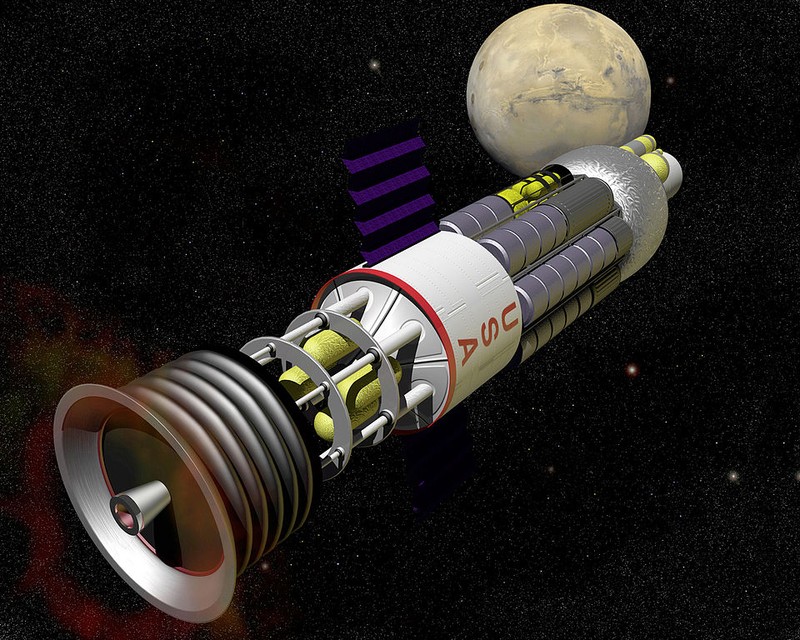
Project Orion's Dream Deferred: How Today's Materials Science Finally Enables Freeman Dyson's Nuclear Pulse Vision

In 1959, Freeman Dyson and Ted Taylor believed they could land humans on Mars by 1964 using nuclear pulse propulsion—spacecraft literally pushed by atomic explosions. Their Project Orion achieved breakthrough thrust-to-weight ratios and specific impulse values that chemical rockets still can’t match, but the engineers were constrained by 1950s materials that couldn’t withstand the extreme conditions. Today’s advances in carbon nanotube composites, refractory metal alloys, and ultra-high-temperature ceramics are finally providing the materials foundation that could make Dyson’s atomic dreams reality.
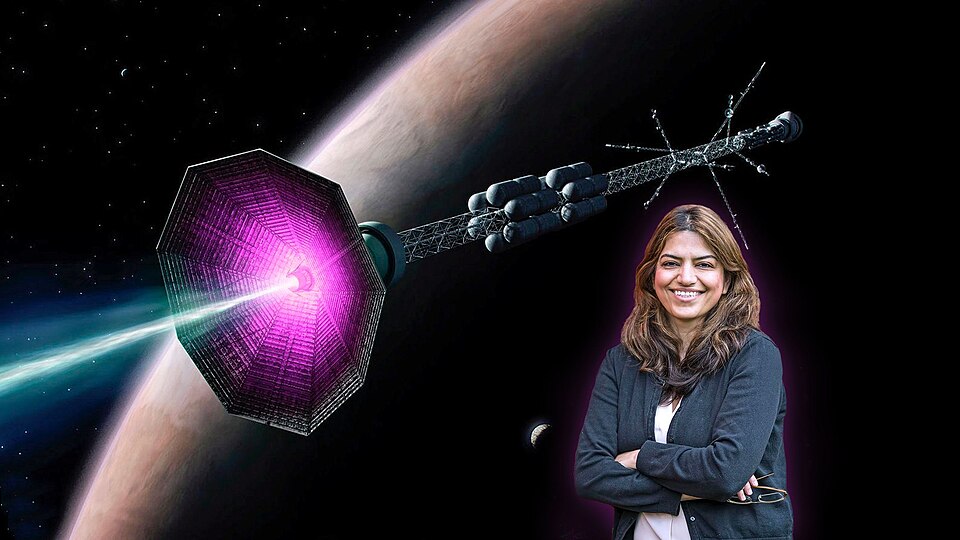
Princeton Plasma Physics Laboratory physicist Dr. Fatima Ebrahimi with an artist's concept of a fusion rocket designed for interstellar travel. The revolutionary propulsion system combines magnetic plasma confinement with direct thrust generation, potentially enabling spacecraft velocities approaching 10% light speed. Credit: PPPL/Elle Starkman

The 30,000 Kilometers Per Second Dream: Why Fusion Ramjets Could Turn a 72,000-Year Journey to Alpha Centauri Into a 45-Year Road Trip

A spacecraft accelerates away from Earth, its fusion engine burning hydrogen scooped directly from the void between stars. At 30,000 kilometers per second—10% the speed of light—it crosses the continental United States in just 10 seconds. This isn’t science fiction: it’s the engineering goal of fusion ramjet technology that could transform interstellar travel from a multi-generational odyssey into a single human lifetime. Recent breakthroughs in fusion ignition and magnetic field engineering are bringing this 1960s concept tantalizingly close to reality.