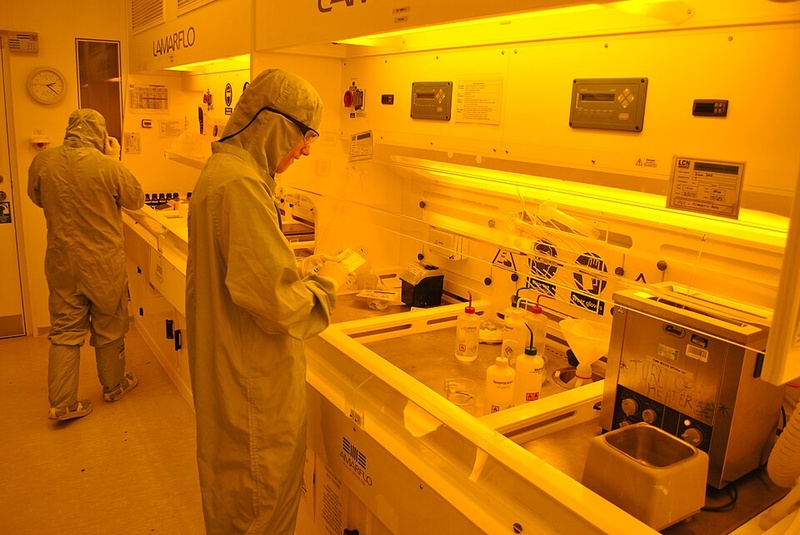
Researchers work in a state-of-the-art photolithography cleanroom at the London Centre for Nanotechnology. The extreme precision required for modern semiconductor manufacturing demands contamination-free environments where even a single dust particle can destroy thousands of transistors. Credit: Wikimedia Commons

ASML's 0.55 NA Revolution: The $400M Machines Enabling 2nm Chips

ASML’s High-NA EUV systems achieve 0.55 numerical aperture—double the resolution of current tools—enabling critical dimensions below 10 nanometers for the first time. These $400 million machines represent the most complex manufacturing equipment ever built, with mirror precision approaching the theoretical limits of physics. Intel received the first production system in December 2023, marking the beginning of true 2nm manufacturing capability that could deliver 50% performance gains in next-generation AI processors.

A 450mm silicon wafer shows the manufacturing precision needed for advanced semiconductors—one contamination speck can ruin millions of transistors. Credit: Wikimedia Commons

The $10 Billion Gamble: How Samsung and TSMC's 2nm Race Hinges on Manufacturing Reality, Not Just Physics

Samsung’s 2nm Gate-All-Around transistors achieve breakthrough densities of 300 million transistors per square millimeter—but manufacturing yields of just 40% versus TSMC’s projected 60% could cost an extra $2 billion per fabrication plant. The technology works brilliantly in laboratory demonstrations, yet the gap between ‘functional in research’ and ‘profitable at volume’ determines which company will control the future of AI processors. This isn’t just a technical race—it’s an economic battle where manufacturing precision, not pure innovation, decides the winner.